The seven principles for making marriage work are a set of habits — not techniques, not exercises — that describe how couples keep a marriage running between the dramatic moments: staying curious about each other, answering small approaches for attention, arguing about the problem rather than the person, and agreeing on what the marriage is for. They come from The Seven Principles for Making Marriage Work, a book by researcher John Gottman and Nan Silver.
This page is our own plain-language description of that framework, written for couples in a first marriage who want the shape of the idea before deciding whether to read the source. It is not a summary licensed by anyone, not a reproduction of the book’s questionnaires, and not a substitute for the book itself. Where the wording here differs from the original, the original wins. Checked: 2026-09.
What are the seven principles for making marriage work?
They are descriptions of ordinary marital behaviour, drawn from long-running observational research on couples talking, and organised as things a couple does rather than qualities a couple has. Some describe an ordinary week — attention, affection, curiosity. Others describe what happens when the two of you disagree. The bet in all of it is on the ordinary week: what the two of you do when nothing is wrong is what remains available when something is.
The framing matters more than the list. Advice aimed at married couples starts from breakdown and works backwards: something has gone wrong, here is the repair. The principles start from friendship and work forwards — the claim is that the quality of the ordinary week sets how a disagreement goes on Thursday, not the other way round.
That claim has a research background. In Gottman and Levenson’s research on conflict and marital breakup, the way couples behaved and the way their bodies responded during disagreement were studied against what happened to those marriages later. We are deliberately not attaching any prediction figure to that work — the much-repeated accuracy percentages are not something we will print — but the direction of the finding is the reason the framework spends so much of its attention on conflict rather than on romance.
The book itself is The Seven Principles for Making Marriage Work, published by Harmony. Everything we cite, and where we got it, sits on our sources page.

What does each principle ask you to actually do?
Each principle converts into a behaviour you could describe to a friend without using any special vocabulary. Below is our behavioural reading of each one, in our own words, with the part that summaries leave out.
Keep your picture of each other current
The first principle asks you to keep knowing the person you are married to as they change. Not the version you married — the one currently at the kitchen table, with a different job stress, a different worry about their mother, a different opinion about where you should live. The behaviour is asking, and then updating what you think you know.
It is easy to assume this happens automatically, and it does for a while. Then the questions narrow to logistics, and both people keep answering an internal quiz they filled in long ago.
- For example, a wife who could once have named every colleague her husband complained about discovers, on a long drive, that he has not mentioned anyone from work since he changed jobs, and that she cannot picture his day at all.
Say the good part out loud
The second principle asks you to keep affection and respect audible. Thinking well of your partner is not the same thing as their knowing it. This one is uncomfortable for anyone who finds praise slightly embarrassing, and the discomfort is no measure of how much the habit is doing.
The behaviour is small and specific: noticing what your partner did and naming it, rather than noticing what they did not do and naming that. Not compliments about their appearance — observations about the person.
Answer the small approaches
The third principle is the one that needs the least explaining. Across a day, each of you makes small approaches for attention: a comment about something on the news, a hand on a shoulder, a photo held up across the room. The behaviour is answering them — briefly is fine.
- For example, a husband says “look at this” about something on his phone while his wife is reading. The answer that counts is not a conversation; it is looking up, saying something, and going back to the book. The one that costs is “mm” without lifting her eyes, repeated across a season.
Nobody answers every approach, and the framework does not ask for that. What matters is the direction of travel — whether approaches land somewhere or land nowhere. More on the mechanics of this in how couples talk when it counts.
Let each other have influence
The fourth principle asks each partner to be genuinely movable: to let the other person’s opinion change a decision, including decisions where you consider yourself the expert. The behaviour is visible in outcomes. If you can name recent decisions where your partner’s view changed yours, influence is flowing. If you cannot, it is not, whatever you both believe about your open-mindedness.
This principle is about power, and it is closely related to what we cover in boundaries between equals — influence and boundaries are the same negotiation seen from two sides. The version that causes trouble is not the partner who refuses outright. It is the partner who listens carefully, thanks the other for their view, and then does exactly what they were going to do, every time. Being heard and having no effect is its own kind of silence, and people notice it long before they can name it.
Accepting influence also has a limit that summaries skip: it is not agreeing. A decision can go your way after a genuine argument. What the principle asks is that the outcome be reachable from both sides, not that one of you concede as a habit.
Settle what can actually be settled
The fifth principle separates the disagreements that have a solution from the ones that do not, and asks you to actually finish the first kind. Whose turn for the bins, which weekend to visit which family, what time the alarm goes off — these have answers, and they stay open because neither of you has scheduled the boring conversation that closes them.
The behaviour: name the disagreement narrowly, decide, write it somewhere both of you can see, revisit it when it stops working.
Unstick the ones that never resolve
The sixth principle is about the arguments that come back again and again in a new costume: how much mess is acceptable, how much time family gets, how spontaneous life should be. The framework’s position is that some of these are carried for the length of a marriage, and that the goal is movement rather than resolution — being able to talk about the thing without the conversation going nowhere.
- For example, consider a couple who have argued about tidiness since they moved in together. The unstuck version is not a spotless flat. It is that each of them can say what tidiness means to them — one grew up in chaos and finds mess frightening, the other associates cleaning with being inspected — and can then negotiate a specific room rather than a character trait.
Build a shared sense of what this is for
The seventh principle asks the two of you to have something the marriage is about beyond administration: rituals, plans, a sense of what you are building. It sounds the softest and is the one that turns out to be missing when the practical parts are running fine and the marriage still feels thin.
The behaviour is unglamorous — the things you always do, in the way you always do them, that belong to no one else.
| Principle, in our words | What it asks | This week |
|---|---|---|
| Keep your picture current | Know who your partner is now, not who they were | Ask about something you have not asked about in a long time, and listen to the answer without solving it |
| Say the good part out loud | Make respect and affection audible | Name one thing your partner did well, on the day they did it |
| Answer the small approaches | Respond when they reach for your attention | For an evening, look up every time you are spoken to |
| Let each other have influence | Be genuinely movable on real decisions | Take one decision that is 'yours' and ask what they would do |
| Settle what can be settled | Close the solvable arguments properly | Pick the smallest recurring logistics fight and finish it in writing |
| Unstick what never resolves | Move the permanent disagreement, don't win it | Ask what the recurring argument means to them, before defending your side |
| Build shared meaning | Have something the marriage is about | Protect one ritual — a meal, a walk, a Sunday — from being cancelled |
One principle a week, in your inbox
That did not go through. Nothing was saved and nothing was sent. Try the address again, or write to us directly and we will add you by hand.
- What arrives
- One question worth asking your spouse this week, and the shortest honest account of when it works.
- What does not
- No rules with numbers in them, no promises about outcomes, and no third party ever gets the address.
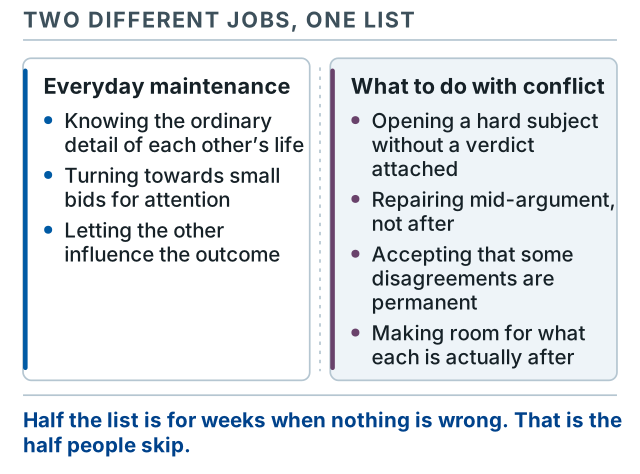
Which principles are about everyday maintenance, and which are about conflict?
The earlier principles describe the ordinary week and the later ones describe disagreement, and the order is not decoration. The framework’s argument is that the maintenance principles are what make the conflict principles usable: a couple who have kept curiosity, audible respect, responsiveness and influence in circulation are arguing on a different footing from a couple who have not.
That is why “we just need to communicate better” fails as a plan. Technique applied to a friendship that has quietly emptied out reads as technique — the phrasing is right and the warmth behind it is missing, and both people can feel it.
- For instance, a couple who barely speak between Monday and Friday sit down with a script from an article to discuss money. The script is fine. The conversation still curdles quickly, because neither has any recent evidence that the other is on their side. The same script, after a season of answering each other’s approaches, lands completely differently.
The practical implication is an order of operations: if you are choosing where to start, start with the ordinary week. The conflict principles are easier to run and much harder to fake once the maintenance ones are doing their job.
There is one honest caveat about the split. Marriages do not queue up neatly, and a couple in the middle of a live disagreement cannot postpone it until their friendship has improved. The order is a priority, not a prerequisite.
What do the principles not cover?
They do not assess your particular marriage, they do not promise an outcome, and they are not a treatment. A book describes patterns observed across many couples; it cannot see yours, and neither can we. Any page — including this one — that tells you what your marriage is or where it is heading is selling certainty it does not have.
Some specific limits worth naming. The framework is about how two people who both want the marriage behave towards each other. It has little to say about a situation where one person has stopped participating entirely, and it is not designed for circumstances involving anyone’s safety — that belongs with a trained professional rather than with a guide like this one, and we do not cover it anywhere on this site.
The principles also sit inside a research tradition that has its own vocabulary for conflict behaviour. We deliberately do not reproduce that vocabulary here: the terms belong to their authors, and reciting labels is a poor substitute for describing what actually happens in your kitchen.
What this page does not do
A summary of someone else's framework carries specific obligations. Here are ours.
- We do not reproduce the book
- No questionnaires, no exercises, no quoted passages. The behavioural descriptions above are ours; the framework is Gottman and Silver's, and the book is the thing to read if you want it properly.
- We claim no affiliation
- We are not certified by, licensed by, trained by or connected to the book's authors, their institute, or any workshop run under that name. Nobody pays us to mention it.
- We print no prediction figures
- The divorce-prediction accuracy numbers attached to this research circulate online with the study itself nowhere in sight. We link the underlying study and leave the arithmetic alone.
- We do not diagnose your marriage
- A page cannot tell you whether your marriage is in trouble, which principle you are failing, or what happens next. Anyone who says otherwise is guessing on your behalf.
- We do not promise outcomes
- Habits change what a week feels like. They are not a guarantee, and a framework applied by one person while the other declines to participate has a well-known ceiling.
How do you use the principles without turning them into a chore list?
Take one, give it a week, and do not tell your partner they are being worked on. The failure mode here is predictable and slightly funny: one partner reads a summary, announces an improvement programme, and the other partner correctly hears “I have identified what is wrong with you.” The framework becomes evidence in an argument instead of a habit.
A few things that make the difference between a habit and homework.
Start with something invisible. The principles that need no announcement — answering approaches, saying the good part out loud, staying curious — can be run unilaterally, tonight, without a conversation about running them. Nothing here requires your partner’s sign-off.
Attach it to something that already happens. A habit with no anchor evaporates. The walk you already take, the coffee you already make, the drive you already share on Thursday: put the behaviour there rather than inventing a new slot in an already full week.
Let it be boring. The version of this that survives is unremarkable. Asking a real question in the car, looking up from the phone, finishing the argument about the bins — none of it makes a good story, and that is the point. Marriages are maintained in a register too dull to photograph.
Expect the first attempts to be awkward. A new habit in a long marriage announces itself as new. The awkwardness is temporary and not a verdict on the habit.
Skip the audit. Scoring yourselves weekly against the whole list converts a description of marriage into a performance review. If you want a structured version of this, the useful one is a short repeated conversation rather than a checklist — the shape we describe in our question decks and on our page about talking when it counts.
If you would rather work from the source than from anyone’s summary, the book is widely available and inexpensive; our page exists to help you decide whether the framework is the one you want, not to replace it. The rest of this marriage advice guide takes the specifics one at a time — money, chores, time, and the conversations that go with them.
Is there a free PDF of the seven principles?
There is no free PDF of the book that anyone can lawfully hand you, and we do not host one. What circulates online under that name is a mix of course handouts, blog summaries and scanned pages, and the scans are somebody else’s property. If a summary is what you want, this page is ours and it is free. If the framework itself is what you want, the book is the only complete version of it.
Worth knowing before you go looking: the value of the book is not the list. Any summary, including this one, can give you the headings quickly. What a summary cannot carry across is the case material — the transcripts of couples talking, which is where the framework becomes recognisable rather than abstract. That is the part that changes how a reader hears their own arguments.
If cost is the obstacle, libraries carry it, and second-hand copies of the revised edition are common. We have no commercial relationship with any seller and earn nothing whichever route you take.
Are the seven principles the same as “marriage rules”?
No, and the difference is worth holding onto. Rules of marriage are prescriptions handed to a couple from outside — never go to bed angry, split everything down the middle, always say yes to the in-laws. The principles describe what is going on in marriages that run well, which leaves the specifics to the two people involved.
That distinction has practical consequences. A rule can be obeyed while the marriage underneath it goes quiet: a couple can avoid ever going to bed angry because they have stopped saying anything worth being angry about. A description invites a different question — not “are we following this?” but “is this happening here, and what would it look like if it were?”
It also explains why we are wary of any list of marriage rules, including popular ones with neat names. Named conventions can be useful as a starting shape to argue with. They stop being useful the moment either partner starts scoring the other against them, which is roughly the speed at which household rules turn into evidence.
Where this fits with everything else on this site
The principles are the frame; the arguments themselves live in the specifics. Money has its own logic, chores have theirs, and the negotiation about time is different again. The framework is genuinely useful as an organising idea and genuinely unhelpful as an answer to “who pays for their sister’s wedding.”
Read it as a description of what maintenance looks like, then go and have the boring specific conversations. That combination — a decent picture of the ordinary week, plus the willingness to finish an unglamorous argument — is close to the whole of what anyone can honestly recommend.