A search for questions for married couples starts in an ordinary place: a quiet dinner, a long drive, a Friday evening that both of you protected and neither of you has anything to say into. Nobody is upset. There is simply nothing queued up except the logistics of the week.
A question deck is a prepared set of prompts a couple can open without first deciding what to talk about, so the effort goes into answering rather than into finding a subject. That is the whole mechanism. It sounds thin, and it is the reason decks work: what runs short when you talk to someone you have lived with for years is not honesty. It is inventory.
This page sorts five sets by the moment they fit, links each one, and says plainly what a deck cannot do. If you only want the questions, the table below is the shortest route.
What makes a question worth asking your spouse?
A question is worth asking when it cannot be answered with “fine”, does not require either of you to defend a past decision, and asks about something current rather than something settled. Those three filters are strict, and plenty of what circulates online does not pass them. A question that survives them is small, specific, and about the present tense of a life you are both inside.
The failure mode of bad questions is easy to hear. “Are you happy?” is enormous, unanswerable in a sentence, and lands as an accusation on a tired Wednesday. “What was the best part of today, even if it was small?” asks for the same information and can be answered without a summit.
Three properties matter here:
- It asks for a story, not a verdict. For example, “what is something you were looking forward to this week that nobody noticed?” gets an actual answer late on a weeknight. “Do you feel supported?” gets a shrug and a change of subject.
- It is about now. For instance, a question about which part of the weekend your spouse would keep if only one part survived tells you where their week is going. A question about why they behaved a certain way years ago starts a trial.
- It has no correct answer. Consider the difference between asking your partner what they would do with an unexpectedly free afternoon and asking whether they think the two of you spend enough time together. The first invites a description. The second names a grievance and hands them a position to hold.
There is an older idea underneath all of this, and it is worth naming honestly rather than dressing up. In The Seven Principles for Making Marriage Work, researcher John Gottman and Nan Silver argue for keeping an updated picture of a partner’s inner life: current worries, current hopes, who annoyed them this month. A couple whose picture stopped updating years ago, on their account, has a harder time of the rest of married life. We have no tie to those authors or their organisations, and our sources page says how we check what we cite. A question deck is simply the cheapest way we know to keep that picture current. It is not a programme and it does not promise anything about your marriage.
That is also why the decks below are not ranked by depth. A deep question asked at the wrong moment does less than a silly one asked at the right table.
A question you write yourself has an advantage no printed card can have: it is local to a week only the two of you lived through. A deck is scaffolding for that: read a card, notice it is not quite the question you wanted, and ask the one it reminded you of instead. Consider a prompt about work that lands as the wrong question because the real subject that month is a friendship going quiet. The card still did its job. It got somebody talking first, which is the part that is hard to do from an empty table.
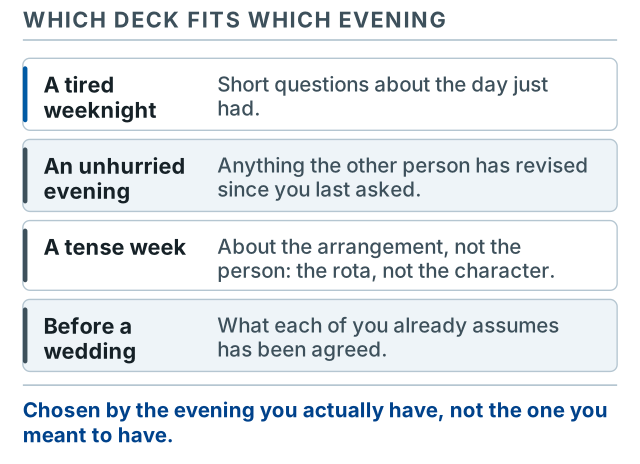
Which deck fits which evening?
Pick by the moment, not by how serious the questions sound. Each of the five sets below was built around a specific situation: a game you can play on the sofa, an ordinary evening that needs one good conversation, a table for two. The other two cover the months before a wedding, and the questions asked in a counsellor’s room that work perfectly well at a kitchen table.
| Deck | The moment it fits | What it asks about | Page |
|---|---|---|---|
| How well do you know your spouse | A game night on the sofa; you both want something light with a real payoff | Preferences, habits, small facts that quietly changed | /questions/how-well-do-you-know-your-spouse/ |
| Questions to ask your spouse | Any ordinary evening — the biggest library, sorted from silly to genuinely deep | Everything from road-trip nonsense to a hard week | /questions/questions-to-ask-your-spouse/ |
| Date night questions | A table for two, a booked babysitter, limited time | The present tense: this year, this season, what you both want next | /questions/date-night-questions/ |
| Questions before getting married | Engaged, or newly married and still deciding how things will run | Money, family, work, where you live, what you each assume | /questions/before-getting-married/ |
| Marriage counselling questions | You want the questions a professional would open with, used at home | Patterns, expectations, what each of you avoids raising | /questions/marriage-counseling-questions/ |
The get-to-know deck is the one to open when the evening needs a shape. You answer on each other’s behalf and then compare. Consider a couple who both write down the same Thai place they have been ordering from for years, except one of them went off it in the spring and never said so. The wrong answer is the part of the evening worth talking about, not the score.
The general library is the largest set and the one that fits the widest range of evenings. It runs from silly through everyday to deep, so you can match the weight of the question to the weight of the room. That page sets out the scale and where each range belongs; the short version is that the range you reach for should be one the evening can genuinely carry.
Date night questions are shorter and firmly in the present tense, because a table for two has a time limit and a bill arriving. If you need somewhere to use them, the date night ideas page is the companion.
Questions before getting married is the practical set: money, family, work, where you live, and the assumptions each of you has never said out loud because they seemed obvious. It works just as well in the first year of marriage, when those assumptions meet reality for the first time.
Marriage counselling questions collects opening questions of the sort a professional might use, written for use at your own kitchen table. It is not therapy and it is not a substitute for it. Where something has been heavy for months, or where safety is part of the picture, the useful next step is a qualified professional, not a better question.
If none of those descriptions quite matches your evening, the general library is the safe default, because it is sorted by weight and you can pick from either end of it. Which deck you pick decides less than the state of the room does. What decides whether an evening goes anywhere is the energy in it and whether both of you are actually free. For example, a deck opened in the last half hour before sleep, with one of you still answering messages, will do less than a plainer deck opened on a Sunday morning with the day still ahead. Match the moment first, then the deck. The printable set exists for exactly that reason: with all five on the table, choosing takes a second rather than a search.
The printable set: all five decks on paper
That did not go through. Nothing was saved and nothing was sent. Try the address again, or write to us directly and we will add you by hand.
- What arrives
- One question worth asking your spouse this week, and the shortest honest account of when it works.
- What does not
- No rules with numbers in them, no promises about outcomes, and no third party ever gets the address.
How do you use a question deck without it feeling like an interview?
One question at a time, both of you answering it, and an explicit right to skip any question without explaining why. Those three rules are what separate a conversation from a questionnaire. The moment one person is asking and the other is being examined, the deck stops working, and no amount of good questions will rescue it.
A few practical things that make the difference between a deck you abandon and a deck you keep coming back to:
- Answer first, then ask. Going first costs you the safety of hearing their answer before committing to yours, which is exactly why it lowers the stakes for them.
- Follow up once. The second question is where the real answer lives. “What made that the best part?” is worth more than the next card in the pile.
- Do not schedule it into a ritual on the first night. Announcing a new weekly practice puts a performance review on the calendar. Open the deck; see whether either of you reaches for it again.
- Stop early. Ending while you both still want one more question is a reliable way to get another evening.
Two situations are worth naming. For example, one partner is enthusiastic and the other agreed to be polite: ask one question, take the short answer without commentary, and put the deck away. For instance, a couple with small children and no uninterrupted hour: the car works better than the table. Sitting side by side, with something else to look at, removes the eye contact that makes a heavy question feel like a confrontation.
Imagine an evening where a question lands badly and the room goes quiet. That is not evidence that decks do not work for you. Read it instead as a question heavier than the day had room for. The repair is unglamorous: say so out loud, put the card back, and ask a lighter one. Decks are forgiving that way, because nothing about them has to be finished in one sitting, and an evening that ends early leaves the rest of the pile waiting rather than spent.
The right to skip is worth stating before you start rather than negotiating in the middle. A pass used without an explanation costs nothing; a pass that has to be justified turns the deck into the very interview you were trying to avoid. Skipping is also information of a mild, unalarming kind: a question set aside on a Tuesday can come back answered a week later, unprompted, once the person has had time to work out what they think. Nothing is gained by pressing at the table.
What do you do with an answer you did not expect?
Ask a second question instead of reacting to the first. An unexpected answer can be unfinished rather than alarming — a half-formed thought that came out sharper than intended, or something your spouse has been carrying quietly and has never had a reason to say. Reacting closes it. Asking keeps it open long enough to find out what it actually was.
The instinct to defend arrives fast, and it is understandable: an unexpected answer can sound like a verdict on you. “I’ve felt a bit invisible this year” is not a charge sheet, but it lands like one late at night. The most useful move is boring. Repeat back what you heard, ask what it looks like on a normal day, and resist the urge to solve it inside the same conversation.
Some answers need a different conversation than a deck can hold. If what surfaced is about distance rather than a single evening, reconnecting with your spouse is the longer route. If the problem is that hard subjects reliably turn into arguments, that belongs on communicating with your spouse, which is about the mechanics of the conversation rather than the prompts that start it.
One boundary we hold on every page here: we describe conversations, not diagnoses. An answer that surprises you belongs to the moment it was given, not to the health of a marriage, and nothing on this site can tell you what your relationship is.
What you do the next day carries further than what you said that night. An answer that took effort to give is worth referring back to plainly — asking how the week went for the thing they mentioned, without ceremony and without turning it into a project. Consider a spouse who said they had been dreading a standing Thursday meeting: the useful follow-up is a short question on Friday, not a rearrangement of their calendar. Being heard once is pleasant; being remembered a day later is what makes the next question easy to answer.
What if you have been married for years — is there anything left to ask?
Long marriages are where decks earn their keep, because the assumption that there is nothing left to ask does not hold up. What runs out is not material, it is prompting. You already know how your spouse takes their coffee, so the mind concludes it knows everything else, and the questions stop.
Change arrives in small, unannounced increments. The job that used to be interesting stopped being interesting sometime last spring. The friendship that mattered most quietly cooled. The plan for where you live later on shifted after a conversation with a sibling that never got repeated at home. None of that arrives as news. It only surfaces when somebody asks.
For example, a question as plain as “what has changed for you this year that I might not have noticed?” has room to run in a long marriage, precisely because nobody has put it recently. The get-to-know deck is built around that gap between the answer that used to be true and the one that is true now.
If you are earlier in this — first year, first shared budget, first argument about whose family you visit at Christmas — the main guide to marriage advice maps where each of those conversations lives on this site. The questions before the wedding set covers the ones worth having before they arrive by accident.
What this page doesn't do
Question decks are a small, useful tool with clear limits. Here is where ours stop.
- No scoring, no verdict
- Nothing here interprets your answers. There is no threshold, no result, and no reading of what a 'wrong' answer means about your marriage. Any page offering that is guessing.
- No promises about outcomes
- A deck of questions is an evening, not a repair. We do not claim conversations save marriages, and we would not know how to prove it if we did.
- No numbers we cannot source
- This niche runs on repeated statistics with no traceable origin — the ratios, the percentages, the famous number of years couples supposedly wait. We publish none of them. Our checking process is on the sources page.
- Some subjects are not deck subjects
- A stretch that has not lifted for months, one of you struggling in a way an evening does not touch, anything to do with safety at home — those belong with a qualified professional, and a page of questions is not where that belongs. The sources page is where we point outward.
- No secret list
- There is no set of questions that opens a person up. The decks lower the cost of starting; the rest is two people deciding to answer honestly.
Everything on this page is written by the editorial team behind this guide, without personas or invented credentials, and checked against the sources we actually opened. Cross-topic questions readers send us — including the whole family of numbered rules people ask about — live on the site FAQ. Checked: 2026-09.