
The best question to ask your spouse is the one that matches the evening you are actually having. A spousal question is a prompt with a weight: light questions ask for a preference or a memory, middle questions ask for an opinion about your shared life, and deep questions ask someone to say something they have not finished thinking about yet. A list that ignores weight will hand you a good question at the wrong moment, and the moment is what decides.
That is the whole reason this library is sorted the way it is. Sorting by theme — travel questions, food questions, marriage questions — is the familiar approach, and it tells you nothing about whether the thing will work late on a Tuesday when one of you has been staring at a screen since morning. Sorted by weight, you can pick from the range the evening can carry.
There is a second, quieter reason. A question that is too heavy for the room does damage that the topic itself never would. It arrives as a test, the other person hears an exam, and the next question you ask gets a shorter answer than it deserved. Weight is not about depth being better. It is about the ask matching what is available.
What separates a light question from a deep one?
The difference is how much the answer costs. A light question can be answered instantly and truthfully with no risk attached. A deep question asks your spouse to go looking for something first — a worry, a hope, a change of mind they have not announced — and then say it out loud to the person most affected by it.
Between the two sits the middle range, which is where an ordinary marriage conversation can live. Middle questions are about the shared life rather than the self: how the week is arranged, what the two of you have quietly stopped doing, what next month is supposed to look like. They cost something, but not much, and they are the range that a normal weeknight can hold.
| Weight | What the question asks for | Where it fits | What goes wrong |
|---|---|---|---|
| Light | A preference, a memory, an absurd choice — answerable in one breath | Cooking, driving, the end of a long day, anywhere with noise | Nothing much. The worst case is a shrug |
| Middle | An opinion about your shared life: time, chores, plans, money | A walk, a quiet kitchen, a table where neither of you is in a hurry | Turns into logistics or a grievance list if you ask it while annoyed |
| Deep | Something unfinished: a fear, a hope, a change nobody has named yet | Long car rides, late evenings, a weekend morning with nothing after it | Lands as an ambush if there is no time, or as an audit if there is no warmth |
A useful test before you ask anything: could your spouse answer this while tired, and would you answer it yourself right now. If both answers are yes, the weight is probably right. If the second answer is no, the question is either too heavy for the moment or you were planning to ask it rather than share it.
- For example, “what do you want out of the next few years” is deep, vague and unanswerable at the end of a workday. “What would you change about how our weeks are arranged” is the same concern at middle weight, and it can be answered while drying dishes.
- For instance, “why do we never do anything any more” is an argument wearing a question mark, and it gets defended rather than answered. “What is something we used to do that you would put back into a month?” asks for the same thing and gets a suggestion instead of a case.
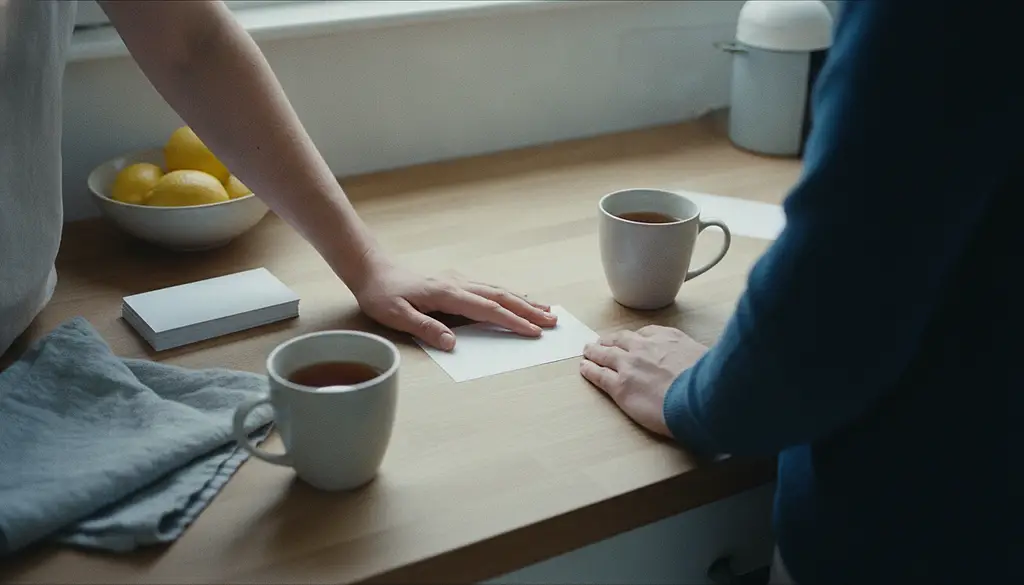
Which questions work on an ordinary evening?
Light and lower-middle questions work on an ordinary evening, because an ordinary evening has no spare capacity in it. The aim on a normal Tuesday is not revelation. It is a short stretch of mutual interest that neither of you had to schedule, which is what conversation starters for married couples are actually for.
The silly deck. Not filler — silliness is the cheapest way back into each other’s company after a flat day, and it asks nothing of anyone.
- What was the worst haircut you have ever had, and who did you blame?
- Which household chore would you pay a stranger to do forever?
- If we had to move to another town tomorrow, where are you picking?
- What is the stupidest thing you have argued about with a colleague this year?
- Which of my habits would you quietly retire if you had one vote?
The random deck, for the middle of a car ride or the wait for the kettle. Random questions to ask your spouse work because they have no relationship content at all, which is precisely what makes them restful.
- What did you believe as a child that turned out to be completely wrong?
- What would you do with a free Saturday if nobody needed anything from you?
- Which meal would you eat every day without getting bored?
- What is something you have wanted to try and never mentioned?
- Which year of your life would you live again, and which would you skip?
The lower-middle deck, once the light ones have warmed the room. These are about your shared week rather than the marriage, and they can produce something actionable by accident.
- What part of this week would you happily delete?
- Which evening this month felt like a good one, and what made it good?
- What is one thing I do that makes the week easier, and one thing that makes it harder?
- What are we spending time on that neither of us actually enjoys?
What these three decks have in common is that they can be answered while doing something else. None of them needs anyone to sit down, clear a table, or first work out what is really being asked. That is the property that gets a deck used on a weeknight rather than admired and shelved.
The printed deck, sorted by weight
That did not go through. Nothing was saved and nothing was sent. Try the address again, or write to us directly and we will add you by hand.
- What arrives
- One question worth asking your spouse this week, and the shortest honest account of when it works.
- What does not
- No rules with numbers in them, no promises about outcomes, and no third party ever gets the address.
Which questions work in a hard week?
In a hard week, drop the weight rather than raise it. The pull during a bad stretch is towards the biggest question available — what is happening to us, are we all right — and that question is the least answerable one in the house at exactly the moment it gets asked. Questions to ask your spouse during hard times work when they are small, concrete and answerable while depleted.
Hard weeks come in different shapes: a stretch of illness, work that has eaten every evening, a family crisis, or a flat patch neither of you can name. What they share is that capacity is gone. The questions below assume that.
When the week has been heavy from the outside:
- What is the one thing on your list I could take off it today?
- Do you want company, quiet, or to be left completely alone this evening?
- What would make tomorrow morning slightly less awful? (Answer it in tasks, not moods.)
- Is there anything you have been dreading that we could just get over with this week?
When the flatness is between you rather than around you:
- What have we stopped doing that you actually miss?
- When did you last feel like we were on the same side of something?
- What would you want more of from me that I would not guess on my own?
- Is there something you have been not-saying because the timing has never been right?
That last one is the heaviest question on this page, and it should be asked rarely, in a setting with time after it. Consider a Sunday morning with nothing scheduled: the question has somewhere to go. Asked late at night before a working day, the same words produce either a rushed answer or a sleepless silence.
One boundary worth stating plainly. Questions are a conversational tool, not a treatment. If a hard stretch has run on without lifting, if either of you is struggling in a way that a good evening does not touch, or if safety is part of the picture, a page of questions is not where that belongs and the useful next step is a qualified professional. The reading and the routes we point to are listed on our sources page.
Which questions bring you back to each other?
Reconnecting questions work by rebuilding ordinary knowledge first, not by going straight to the state of the marriage. A drifted couple has not necessarily stopped loving each other; what has gone is the small facts — what this week is like, who is annoying at work, what is being looked forward to. Questions to ask your spouse to reconnect start there.
The order matters more than the content. A drifted couple asking each other heavy questions on the first evening can end up in an audit, because there is no shared recent material to hang the answers on. Light and middle first, over several evenings. Depth arrives once there is something to be deep about.
Rebuilding the everyday:
- What is the most annoying thing in your week right now, in detail?
- Who at work would I recognise if you described them, and who would I not?
- What are you looking forward to in the next month, however small?
- What has changed for you this year that I might not have noticed?
Getting closer on purpose. Intimate questions for married couples do not have to be about sex to be intimate; the intimacy is in the answer being unguarded. This page keeps to the closeness range on purpose.
- When do you feel most like yourself around me?
- What do I do that makes you feel wanted, and what do I think works but does not?
- What was the moment you first thought this might actually work between us?
- Which version of us — early on, mid-way, now — would you want back for a week?
The case that ordinary curiosity about a partner’s daily life is structural rather than decorative is not ours. It belongs to Gottman and Silver’s practical guide, which we cite without any connection to its authors; our own reading of it sits on the seven principles. Where the questions above sit inside a longer effort to close a gap is covered in reconnecting with your spouse.
- Imagine an ordinary evening where each of you asks a single question from the everyday list and nothing more. No agenda, no follow-up campaign. That is a deliberately low bar, which is the point: it survives a busy month.
How do you ask a heavier question without it landing as an accusation?
Ask it sideways, at a moment that already exists, in words that describe your own curiosity rather than your spouse’s failings. A heavy question lands as an accusation when it is announced, when it arrives with evidence attached, or when it contains the answer you are hoping for. Remove those habits and the same question becomes askable.
Attach it to something. Side-by-side settings carry weight better than face-to-face ones: driving, walking, washing up, the last stretch of a road trip. Nobody has to hold eye contact while thinking, and either of you can look out of a window instead of answering immediately. This is why a long drive can produce a conversation the dinner table never got round to.
Questions to ask your spouse on a road trip are worth choosing before you set off, because the useful part of a long drive is the stretch after the first hour, once the logistics talk has run out and neither of you is watching the other’s face. Long drives carry the middle and deep ranges unusually well, and they come with a built-in exit: silence in a car is ordinary, so an answer can take as long as it takes.
- What did you picture this stage of life looking like, back before we got here?
- What has changed for you since this time last year that we have never talked about?
- Which stretch of the past year would you live again, and which would you hand back?
- If the next few years were yours to arrange, what would you put first?
Ask about you, not about us. “What has this year been like for you” opens something. “Do you think we have grown apart” closes it, because it hands your spouse a claim to agree with or deny. The first phrasing gets you the same information without a verdict in the middle of it.
Do not bring evidence. A question with a case attached is not a question. If you have been counting up examples, the counting will be audible, and the answer you get will be a defence rather than a thought.
Leave the silence alone. A good heavy question leaves a pause. Filling it — with a clarification, an example, a softer version — tells your spouse the pause was the wrong answer. Let it run.
Answer it yourself, second. Going first turns the question into a statement you want matched. Going second turns it into a conversation, as long as you actually go.
A last word on delivery. None of these lines work as a script recited through gritted teeth: a question asked to make a point carries the point, not the question. If what you want is to be heard rather than to hear, that is a different conversation, and it is better served by talking to your spouse without it turning into an argument than by any list.
If you want to test how much everyday knowledge you have to build on before you start, the lighter format in how well do you know your spouse does that without asking anyone to be serious about it. The rest of the decks — date night, before the wedding, and the ones counsellors use — live on the questions hub.
What this page does not do
A question library is a narrow tool. Here is what it deliberately leaves out.
- Interrogate anyone
- There are no questions here designed to catch a spouse out, test their memory against yours, or extract an admission. Those are not questions, and a page that supplied them would be helping with something other than a conversation.
- Read your marriage from the answers
- Nothing your spouse says to a prompt from a website tells you the state of your relationship, and we do not offer scoring, thresholds or interpretations. Answers are material for a conversation, not evidence for a verdict.
- Carry a religious or sexual deck
- The intimacy questions here stay in the closeness range, and there is no devotional framing anywhere on the site. Both choices are deliberate: plenty of collections do those, and readers looking for them know where to go.
- Stand in for professional help
- A written list cannot hear an answer, notice what was left out of it, or ask the next thing — which is the whole difference between a prompt and professional help. Where a subject needs that kind of attention, what it needs is a person, not a better question.
What it is for
- Picking by weight
- A scale that tells you which range tonight can carry, so the question fits the room instead of steering it.
- Having something ready
- Decks for a flat Tuesday, a hard week, a long drive and a slow reconnection, so nobody has to invent a question while tired.
- Asking the heavy ones well
- A short set of delivery rules that keeps a serious question from arriving as a charge.
The reading behind this page is listed with the rest of our references in sources. We re-check these decks on a rolling basis; this one was last reviewed on the date above. Checked: 2026-09.