How well do you know your spouse questions are the party-game version of a serious question: is the person you answer for still the person sitting across from you? A know-your-spouse question set is a list where each of you answers on behalf of the other, then compares — not to produce a winner, but to find the places where your picture of them stopped updating. Long marriages are exactly where that happens, because nobody sends a notice when a favourite order changes or a plan for next year quietly turns into a different plan.
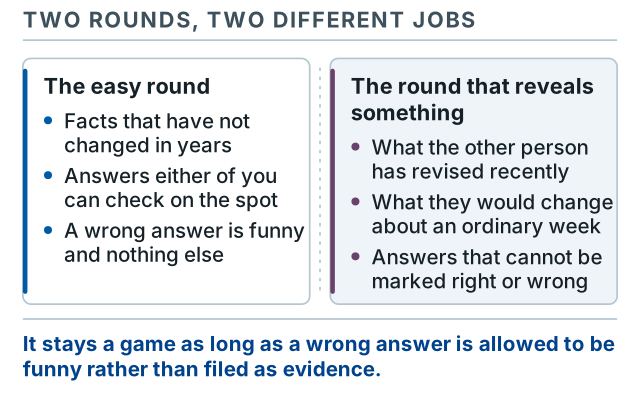
The set below is sorted into two rounds. The first is easy on purpose and is there for the laughs. The second asks about the last year of someone’s life, and it is the round that produces the conversation you came for. Both rounds live in the wider question decks for married couples on this site, and the lighter, no-scoring alternatives sit in our library of questions to ask your spouse.
What is a “how well do you know your spouse” quiz actually testing?
It tests how current your picture of each other is, and nothing else. The format looks like a memory test, which is why it gets misread: a wrong answer reads as proof of not paying attention, when the answer itself may simply have changed and the change was never said out loud.
Preferences drift without ceremony. Someone stops enjoying the restaurant everyone assumes is their favourite. Someone’s worry about work gets replaced by a worry about their parents. Someone who spent years saying they wanted to move stops wanting it and never mentions the reversal, because there was no obvious evening on which to bring it up. The quiz is simply a scheduled occasion for that reporting to happen.
That makes the mismatches the point. A pair who get everything right have had a stable year, or have asked good questions, or both — and the game ends quickly. A pair who miss a run of answers in the second round have information: here are the parts of each other’s lives that moved while the calendar was full. None of that measures the marriage. It marks where the asking should start.
The idea that couples benefit from keeping a detailed, current picture of each other’s worlds is old and well described. Gottman and Silver’s The Seven Principles for Making Marriage Work builds its opening chapters around it, and the practice they describe is unglamorous: ask about the ordinary texture of a partner’s week, keep asking, and expect the answers to move. We cite that book and have no affiliation with its authors or their organisations. Our sources page lists the works we refer to, and our own summary of the argument sits on the seven principles page.

How do you play it so it stays a game?
Set the rules before the first question, because the rules are what keep it from turning into an exam. Each of you writes an answer for the other. Then each of you says what your own answer actually is. Then you compare, and the person who was wrong gets to ask one follow-up question rather than defend themselves.
A short set of rules carries it:
- Anyone can skip a question, with no explanation owed. For example, if the question about next year lands in a week when next year is genuinely unsettled, “pass” is a complete answer and the game moves on.
- The follow-up matters more than the answer. For instance, “you said the mornings are the part you brace for — since when?” is worth more than a correctly guessed coffee order, and it is the whole reason to play.
- No scoring out loud. Consider how differently the evening goes when one of you starts counting: the questions stop being interesting and start being evidence. Keep the tally in the bin where it belongs.
One more piece of practical framing. Play this when both of you have an evening, not at the end of an argument. The set is a closeness exercise, and it does not work as a way of proving a point about who pays attention.
| Round | What it asks about | What a wrong answer points to |
|---|---|---|
| Easy round | Everyday texture: orders, routines, small irritations | A habit changed recently, or the fact never registered in the first place |
| Revealing round | The last year: worries, plans, things they stopped wanting | The change happened quietly and has not had a conversation yet |
| Either round | Anything the other person passes on | Timing, not secrecy — the question is worth asking again another week |
Which questions belong in the easy round?
The easy round asks about the visible surface of a shared life, and it should be genuinely easy. Its job is to get both of you laughing and answering quickly, so that the second round does not arrive cold.
Everyday texture, in roughly this order:
- What do they order at the place you go to most often, and what do they order when they are being good?
- Which chore do they quietly hate most, and which one do they secretly not mind?
- What is playing in their car right now — music, podcast, or silence?
- Which drawer, shelf, or corner of the house would they fix first if they had a free Saturday?
- How do they take a phone call from their mother: standing up, walking outside, or staying put?
- What is the one item of clothing of theirs that you would quietly lose if you could?
- Which friend do they text first with good news, and which one with bad?
- What do they do in the first few minutes after they get home?
- What would they say is their most annoying habit, and does it match what you would say?
- Which meal can they cook without looking anything up?
- What is their idea of a wasted evening?
- Where do they lose things: keys, phone, or glasses?
A couple of notes on this round. It works better out loud than written down, because part of the value is watching each other’s face while the wrong answer arrives. And it is the round to use if you have never done anything like this before, or if one of you finds structured questions faintly ridiculous — it looks enough like ordinary conversation that nobody has to be a good sport about it.
The printable version of both rounds
That did not go through. Nothing was saved and nothing was sent. Try the address again, or write to us directly and we will add you by hand.
- What arrives
- One question worth asking your spouse this week, and the shortest honest account of when it works.
- What does not
- No rules with numbers in them, no promises about outcomes, and no third party ever gets the address.
Which questions belong in the round that actually reveals something?
The revealing round asks about the last year rather than the last decade. That is the whole design: anything from the early years has already been established and repeated, while anything from this year may never have been said in a sentence.
Ask these slowly, and expect to be wrong on some:
- What has changed about them in the last year that they have not said out loud?
- What are they worrying about at the moment that they consider too small to mention?
- Which part of their week do they brace for?
- What did they want a few years ago that they no longer want, and when did that shift?
- What are they proudest of that nobody in their life has congratulated them for?
- Which friendship has gone quiet, and does it bother them?
- What do they think you get wrong about them, gently?
- What would they change about how the two of you spend an ordinary evening?
- What is something they would like to try that they assume you would not want to do?
- How do they feel about work compared with how they felt about it last year?
- What is the thing they most want to have sorted out before this time next year?
- Which question on this list did they hope you would not ask?
Imagine the last one landing: it can be the most productive question in the set, because it identifies the topic without requiring anyone to open it yet. The answer can be noted and left, and the conversation can come back to it another evening.
Some of these questions read as heavy on the page and land lightly in a good mood, and some do the reverse. If a question opens something bigger than an evening — a decision about work, a worry about family, a want that has been sitting unsaid for a while — the honest move is to stop playing and have that conversation properly, or to set a time for it. The game has done its job at that point.
What do you do when the answers do not match?
Treat the mismatch as information and ask one question: when did that change? That single move converts a wrong answer from a small failure into the only part of the evening that will still matter next week.
The unhelpful responses are easy to predict. Arguing with the correct answer — “no, you do like mornings” — laminates an old picture in place, and it teaches the other person that answering honestly costs something. Apologising at length turns their answer into your feelings, and the person who was about to say more stops. Keeping a running total of who knew whom better turns a closeness exercise into a competition that only one of you can win.
The useful response is smaller than any of those. Say that you had the old answer, ask when the new one arrived, and let them talk longer than feels necessary. Nothing needs resolving that night. A gap like that closes by being named out loud, not by being settled on the spot.
If the evening shows that quite a lot has drifted — a run of mismatches in the revealing round, and a sense that neither of you could have guessed — that is a reconnection question rather than a quiz question, and it has its own page: how to reconnect with your spouse. If the difficulty is that conversations like this reliably turn into arguments, the earlier stop is our library of questions sorted by weight, which includes the ones built for a hard week.
One boundary worth stating plainly, because question sets get pointed at problems they cannot address: if a conversation at home feels unsafe rather than merely awkward, a page of questions is not where that belongs, and the route out is a qualified professional. Our sources page is where we point people outward.
What this page does not do
A know-your-spouse set is a small tool with one job. The harm in this genre comes from selling it as something larger.
- Score your marriage
- There is no threshold, no pass mark, and no reading of a result. Any page that tells you what a wrong answer means about your relationship has invented that meaning.
- Predict anything
- A quiz played over dinner cannot tell you where a marriage is heading, and we will not write copy that implies it can. It tells you which facts about each other are out of date.
- Turn into an interrogation
- We do not publish questions designed to catch a partner out or to test their loyalty. Every question here is one you would be content to answer yourself.
- Replace a conversation you already know you need
- If there is a specific unsaid thing between you, a deck of questions is a detour around it. Have the conversation; use the deck for the things you did not know to ask about.
What it does do well
- Give an evening a shape
- Nobody is inventing a question at nine at night. The list has already done that part, and both of you know what happens next.
- Surface the quiet updates
- Preferences, worries, and plans get revised without announcement. This is a scheduled occasion for the announcement.
- Fail safely
- Wrong answers are the interesting part, so the format holds up even in a week where neither of you has much to give it.