
A numbered marriage rule is a naming convention: a label with digits in it, pinned to a habit and then reposted until the label had travelled far past any account of where it came from. The digits belong to the name the way they belong to the title of a parlour game. They are not measurements, and none of them carries a study behind the spacing it proposes.
Those labels are what this page exists for, along with a handful of other questions that cut across every subject on the site and belong to none of them. This page collects both. Each answer is written to stand on its own; the guide that treats the subject properly is linked underneath. If you would rather have the practical version than the vocabulary, start with the main marriage advice guide or go straight to the question decks.
What is the 7-7-7 rule for marriage?
The 7-7-7 rule is a scheduling convention: the digits stand for spacing, not for evidence — a regular date, a rarer night out or away, and a longer trip at a much wider interval. It is a mnemonic somebody wrote down, not a finding, and nothing establishes that spacing as better than any other a household might pick.
What the label is good for is the argument it settles in advance. Time together does not disappear by decision. It disappears because nobody owns the booking, and the calendar fills from the outside in. A rule of thumb, any rule of thumb, gives the booking a place to live.
What it is not good for is measurement. The travel part assumes money, leave and childcare that a household may simply not have, and a couple who never manage the trip have not failed anything. If the weekly part is the only part that survives, our guide to date night ideas is written around exactly that constraint.
What is the 2-2-2 rule in marriage?
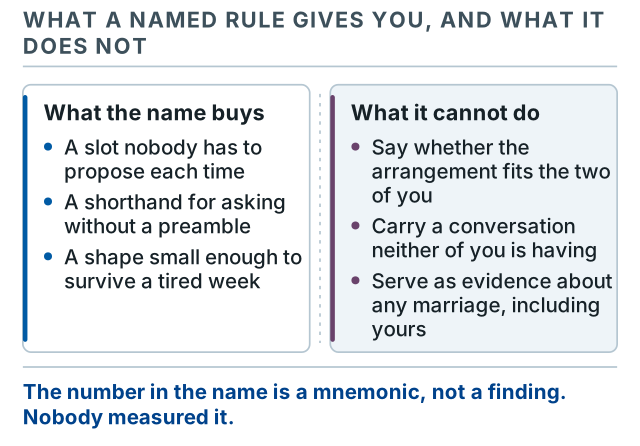
The 2-2-2 rule is the best known member of the same family: the same shape with the digits swapped — a recurring date, a periodic night away, an occasional longer trip. Same status too, a memory aid rather than a measured recommendation, and the arithmetic in it is decoration.
We treat it at length on date night, because that is the page where the practical question lives: how to protect a recurring slot when the week keeps eating it. The short version is that the interval matters less than who books, and that a downgraded date beats a cancelled one.
What is the 3-3-3 rule for marriage?
There is no settled version of the 3-3-3 rule, which is the honest answer. The same label gets attached to a rhythm of dates, to a short set of questions for opening an evening, and to an agreed pause before returning to an argument. Two people using the phrase can be describing different practices to each other without noticing.
That makes it a poor thing to follow and a decent thing to borrow from. The pause version points at something real: a conversation that has stopped going anywhere is better resumed at an agreed time than pushed through at midnight. How to propose that break, and how to come back to the subject, is covered in how to communicate with your spouse.
What is the 3-3-3 rule for intimacy?
The intimacy version of the label narrows the same idea to closeness — some combination of small daily contact, a longer weekly moment, and something less ordinary at a wider spacing, depending on who is retelling it. It has no fixed definition either, and no research attaches to it.
The question underneath it is worth more than the label: what closeness looks like on the weeks when nobody has energy for the ambitious version. That is the subject of how to romance your spouse, and, when the distance has been building for longer, of how to reconnect with your spouse.
What is the 3-6-9 rule in a relationship?
The 3-6-9 rule comes from dating advice, not from marriage advice: it names the habit of pausing to take stock of a new relationship at spaced intervals early on. Married readers meet it by accident, through search results written for people who are still deciding whether to stay.
Its transferable part is the scheduled review, and married couples get more from choosing their own spacing than from importing someone else’s. Our pages for that moment are questions to ask before getting married for couples still ahead of the wedding, and marriage advice for newlyweds for the stretch when the household’s defaults get set.
What are the 5 C’s in marriage?
The 5 C’s are an alliterative list: communication, commitment, compromise, compassion and chemistry, in the version that travels furthest. No authoritative source fixes the membership, and rival versions swap in consideration, connection or care, which tells you what kind of artefact it is: a device for remembering, assembled to be memorable.
As a scorecard it is useless, because nobody agrees on the marking. As an agenda it is fine — a handful of headings is a reasonable way to spend an evening’s conversation, and two of those headings have pages of their own here: boundaries in marriage for the agreements about phones, family and time, and budgeting for couples for the agreement underneath the arithmetic.
| Named rule | What the label is taken to mean | Where we cover the subject |
|---|---|---|
| 7-7-7 | A regular date, a periodic night away, an occasional bigger trip | /date-night/ |
| 2-2-2 | The same shape with the digits swapped; the best-known version | /date-night/ |
| 3-3-3 (marriage) | No settled version; one reading is a pause before resuming an argument | /communication/ |
| 3-3-3 (intimacy) | Small daily contact, a longer weekly moment, something rarer | /romance/ |
| 3-6-9 | A dating-advice habit of reviewing a new relationship on a schedule | /newlyweds/ |
| 5 C's | An alliterative list of qualities, membership not agreed | /boundaries/ |
Are any of these rules worth using?
A named rule is worth exactly one thing: it forces a specific conversation that the week would otherwise postpone. Once the conversation has happened and the household has its own answer, the label has done its job and can be dropped without loss. Nothing is lost by never having heard of it.
- For example, a couple who read about the 7-7-7 spacing on a Sunday do not adopt it. They use it to notice that neither of them has booked anything since spring, and they put a Wednesday in the calendar with the babysitter’s name next to it.
- For instance, the pause version of the 3-3-3 label gives a couple who argue late at night a sentence they were missing: “I want to finish this, not now — tomorrow after work.” The agreed return is the working part; the digits are not.
- Consider the 5 C’s used as an agenda rather than a test. An evening, a heading at a time, no verdicts: what commitment looks like this year, what compromise is costing whoever is paying more of it at the moment.
The failure mode is the opposite move — reading a rule as a standard and measuring the marriage against it. A household that cannot produce the weekend away has learned nothing about itself except that weekends away are expensive.
Why do these rules come with numbers in the name?
Because numbers make a phrase repeatable, and repeatable phrases travel. A label with digits in it survives being retold, screenshotted and reposted in a way that “see each other regularly” does not. That is a property of the packaging, not evidence about the contents.
It is worth separating those labels from titles that merely happen to contain a number. The Seven Principles for Making Marriage Work, a book by researcher John Gottman and Nan Silver, counts the chapters of an argued case rather than prescribing a rhythm; our own summary of what those principles say is at seven principles. The book is described here, not endorsed by anyone behind it — its authors have no involvement with this site.
Where research is worth mentioning on this site, we describe it in words rather than figures — Levenson and Gottman’s work on physiological arousal during conflict, for instance, is cited for what it observed, not for a percentage. The reasoning behind that, and the full list of what we cite, is on our sources page.
Where does each of these questions get a longer answer?
Every short answer above belongs to a page that has room for the exceptions, and the same is true of the questions readers ask that have nothing to do with numbered rules. Three that recur: whether it is normal to feel alone inside a marriage (feeling lonely in a marriage), what to do on the days you cannot stand the person you married (when you hate your spouse), and whether sleeping in different rooms means something (separate bedrooms).
A note on limits, said once and not repeated: if something has been running for a long time, or if anyone’s safety is involved, that is past what a page can do, and it belongs with a trained professional. Everything on this site is written for the ordinary case.
What this page does not do
- Rank your marriage against a rule
- None of the labels here is a standard, so none of them can be passed or failed. A household that keeps none of these rhythms may be doing perfectly well on terms nobody has bothered to name.
- Put research behind a mnemonic
- The intervals in these names arrived without sources and we are not going to supply them retroactively. Where we cannot trace a figure to a primary source, we describe the idea qualitatively or leave it out.
- Diagnose anyone
- We describe conversations and agreements, not conditions. Nothing on this page can tell you what kind of person your partner is, and nothing here predicts how any marriage turns out.
- Replace the full guides
- Each answer above is the short version. Where an answer and its linked page seem to disagree, the page is the one written with room for the exceptions.
New questions land here first and move out to a proper page once enough readers ask them. Checked: 2026-09.