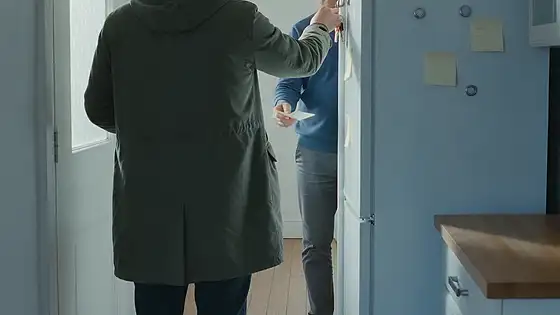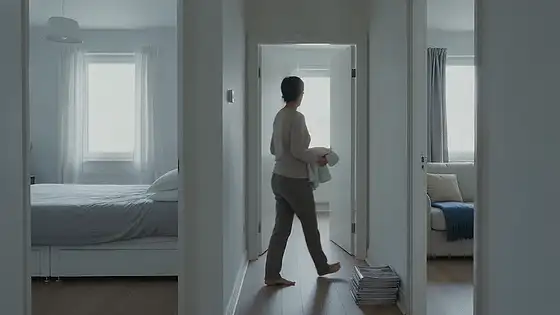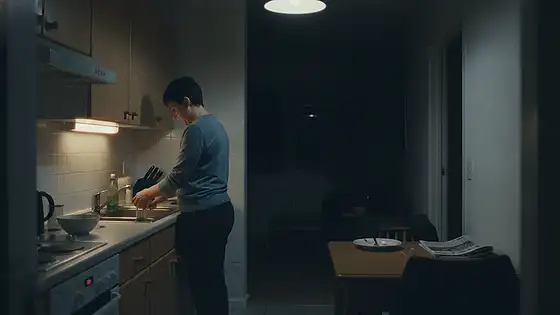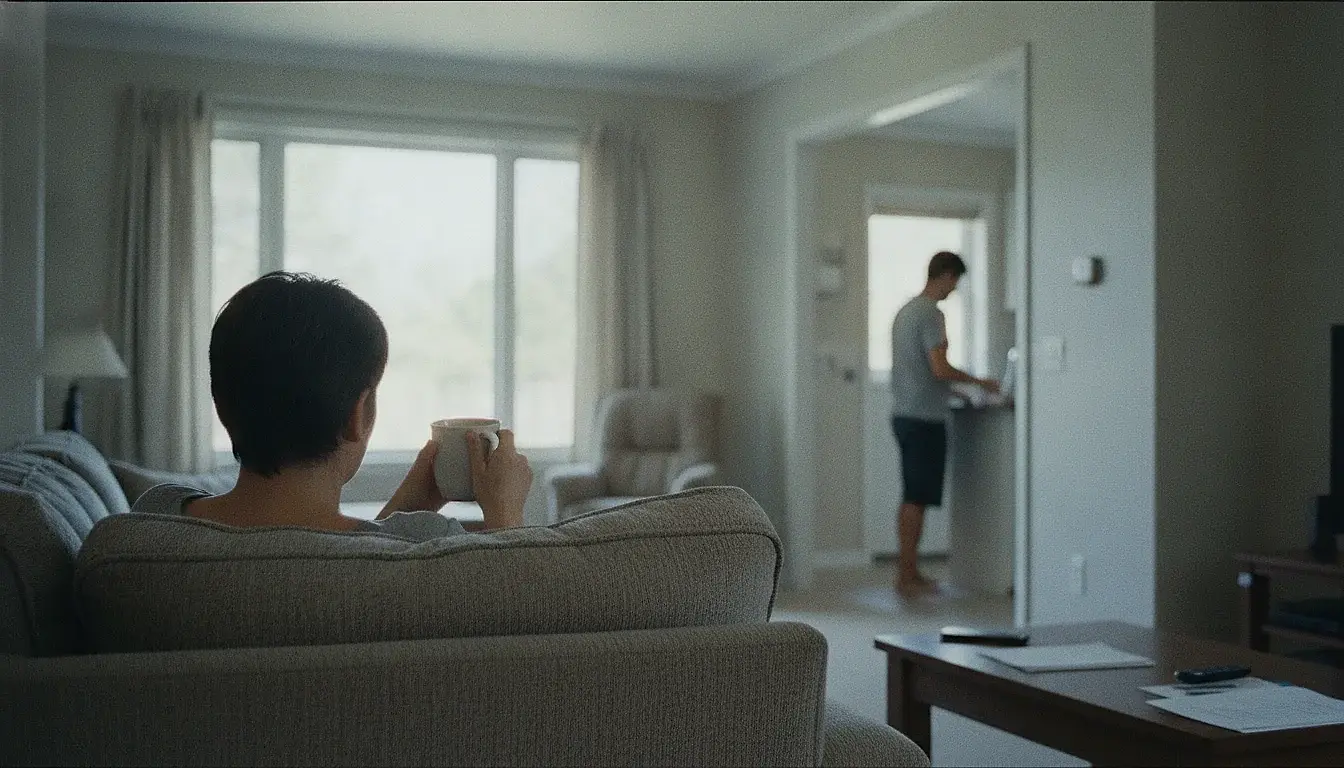
Feeling lonely in a marriage is the experience of being unaccompanied while living alongside someone — the sense that you are known as a schedule rather than as a person. It is a specific kind of lonely, and part of what makes it hard is that it has no obvious cause to point at. Nobody left. Nobody shouted. The house runs. And still, the week can pass without a conversation that either of you would remember on Friday.
What follows is a description of the state itself, a way of raising it that does not arrive as an accusation, the small things that shift it inside an ordinary week, and the point where a website is the wrong thing to be reading. None of it is a reading of your marriage, and nothing here forecasts what happens to it. Checked: 2026-09.
What does feeling lonely in a marriage mean?
Feeling lonely in a marriage means the attention between two people has thinned, not that the relationship has ended or failed. You still share a bed, a calendar and a bank balance; what has gone quiet is the part where one of you is genuinely curious about the other. Loneliness of this kind is about being unaccompanied rather than being alone, which is why it can sit inside a marriage that both people describe as fine.
It helps to separate the states that get folded into the same word. There is being alone, which is a fact about the room. There is solitude, which is wanted rather than dreaded. And there is loneliness, which is the gap between the contact you have and the contact you expected. Marriage raises the expectation sharply — you married the person partly so that someone would know how your week went — so a small drop in contact produces a large gap.
That is also why the feeling arrives with guilt attached. Nothing has been done to you. Your spouse is not withholding anything on purpose; the attention is simply pointed at work, at children, at a phone, at a parent who is ill. Naming the gap can feel like an accusation even when you mean it as a report, and so it goes unsaid for a long time while the season is expected to turn on its own.
- For example, you tell your spouse about a difficult meeting and get “mm” and a scroll, and the story does not get told again because retelling it feels like begging.
- For example, you realise on a Sunday that the only sentences exchanged all weekend were about the dishwasher, the school run, and whether the bins went out.
- For example, you catch yourself saving something interesting to tell a friend instead, because the friend will ask a follow-up question and your spouse probably will not.
None of those scenes is a crisis. Together they are the whole experience: a marriage that functions perfectly and accompanies nobody.
It is also worth being precise about what the feeling is evidence of. It is evidence about the week: how much contact there was, how much of it was logistics, whether anything was asked and answered. It is not evidence about whether your spouse loves you, and it does not settle that question in either direction. Those are separate enquiries, and asking them as one buries the smaller, answerable subject underneath the larger and unanswerable one. If the second question is the live one for you, we treat it on its own page about how to know if your spouse loves you.
Why does loneliness build in a marriage where nothing is wrong?
Loneliness builds because nothing has to go wrong for attention to move. Two full calendars, a demanding season at work, small children or an ill parent will do it without a single argument. Contact narrows to logistics, logistics get answered in fewer words, fewer words invite fewer questions — and the loop tightens quietly enough that neither person can name the week it started.
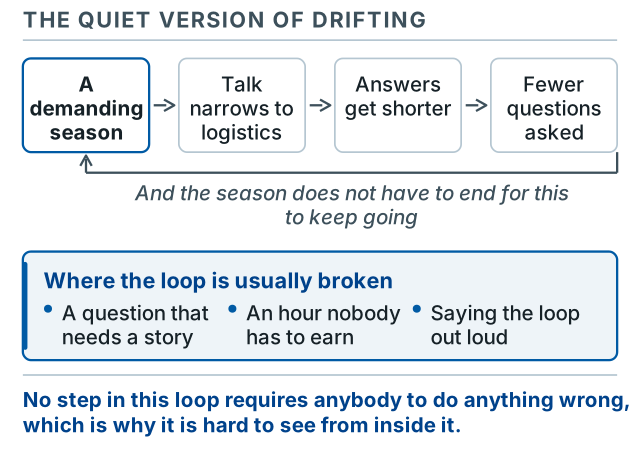
There is a second reason it goes unnoticed for so long. Conflict announces itself; absence does not. A marriage with an argument in it has an agenda item, a thing to return to, an evening where something gets said. A marriage with a gap in it has no agenda item at all — just a Thursday that resembles last Thursday. Researchers have long treated what happens between partners over time, rather than any single evening, as the thing worth watching: Gottman and Levenson’s research on conflict and marital breakup followed couples across years rather than judging them by one conversation. We take the same posture here — patterns over seasons, no forecast about anybody’s marriage — and the first-source material is listed on our sources page.
The third reason is that both people can be lonely at the same time without either one saying so. One assumes they are the only one who noticed; the other assumes their own quietness is being read as contentment. Where that is the arrangement, the conversation lands as a relief rather than as an ambush — which is an argument for having it early rather than for having it perfectly.
There is an asymmetry worth naming, because it causes a lot of unnecessary blame. Noticing the gap first is not the same as having caused it, and it is no mark of being worse at marriage. What noticing tracks is spare capacity that week — who is less absorbed, who commutes alone, who lies awake. Treated as a scorecard, a shared condition turns into an accusation, and the accusation is what makes the subject hard to raise the next time.
How do you say it without it landing as blame?
Say it as a description of a specific evening rather than an assessment of your spouse. “I have been lonely” is a report about you; “you never talk to me” is a verdict about them, and verdicts get defended rather than answered. The difference in wording is small; the difference in what comes back is not.
A few things make the difference. First, pick a scene instead of a span — one evening, not every evening since spring. Second, say what you missed rather than what they failed to do. Third, end with something askable, so the conversation has somewhere to go other than an apology or a defence.
- For instance, instead of “you are always on your phone”, try “on Tuesday I wanted to tell you about the thing with my sister and I could not find a moment. Can we sit down tonight once the house is quiet?”
- For instance, instead of “we never talk any more”, try “I have missed the kind of conversation we used to have on drives. Could we drive somewhere on Saturday?”
- Consider what happens if you open with the sentence you have rehearsed while angry. It is the accurate one, and the one that starts a different argument.
Timing does as much work as wording. A raised subject late at night, after a bad day, with one person already half asleep, gets the worst version of both of you. The same sentence on a weekend morning, or in a car where nobody has to hold eye contact, lands much closer to the way you meant it. More on the mechanics of hard conversations — openings, timing, and how to keep one from turning into the same circular argument — is on our page about how to communicate better with your spouse.
Expect the first attempt to go imperfectly, and plan for that rather than against it. A spouse who hears “I have been lonely” can hear an accusation first and the report second, and the initial reply can be a defence: I work all day, I am here every evening, what more do you want. That reply is not the end of the conversation unless you treat it as one. The useful move is to hold the description steady without adding force — repeat the evening, not the verdict — and to leave the subject open rather than winning it that night. The subject survives better across a few short conversations than inside one long and decisive one.
One warning about the phrasing. Avoid turning the report into a test. “Do you even notice me any more?” is a question with only one acceptable answer, which makes it a trap rather than an opening, and that difference is audible.
What helps when your spouse does not notice?
What helps is asking for something specific and small enough to happen this week, because a vague request for more closeness gives your spouse nothing to actually do. “I want us to be closer” is true and unactionable. “Can we have coffee on Saturday before the kids are up” is small, dateable and either happens or does not — and the fact that it either happens or does not is the useful part.
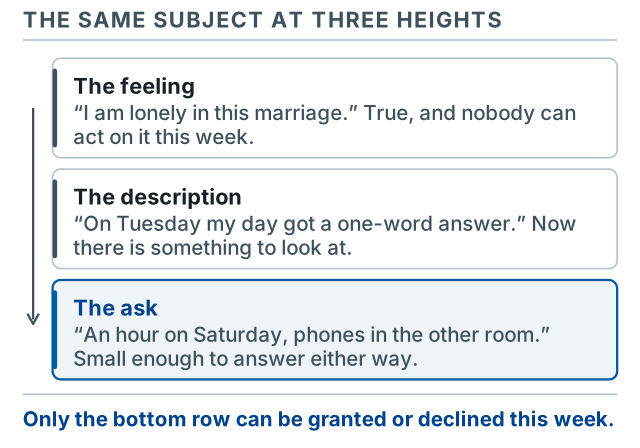
Then watch the response over a stretch of time rather than hours. A spouse who is genuinely elsewhere in their head may need the request repeated before it registers as a request rather than a mood. That is not a character flaw and not a reason to escalate the wording; it is what a distracted person is like. What matters is the direction of travel over a season: does the coffee happen sometimes, does anything get asked back, does the subject stay allowed.
The other half needs nobody’s agreement, and it is worth doing on its own terms. Ask the questions you have been waiting to be asked. Tell your spouse the thing you had saved up for a friend. Answer at more than one word yourself, on the evenings when you would rather not. None of that obliges anyone to reciprocate, and it would be dishonest to pretend otherwise — what it changes is the conditions, and conditions are the part any one person can act on alone. Our page on how to reconnect with your spouse covers that groundwork in more detail, and the wider view of what makes a marriage workable in ordinary conditions sits on our marriage advice pillar.
A few things make it worse, and every one of them is understandable. Keeping a private ledger of unreciprocated efforts, so that the eventual conversation arrives as a case for the prosecution. Testing your spouse silently — waiting to see whether they ask, and counting it against them when they do not. Attaching a consequence you have not thought through to a request that was never clearly made. Each of these converts a solvable gap into a standoff, and none of them gives your spouse the one thing they need, which is a plain statement of what you want and when.
And if you are on the other side of this — if your spouse has told you they are lonely — the worst available answer is a defence of your schedule. The next worst is a promise that is too large to keep. Ask what specifically they missed, agree to one small thing this week, and then do that thing, because a kept small promise resets the subject faster than any amount of reassurance.
A note on the phrase people bring to a search box: what to do when your spouse ignores you. Being ignored and being unnoticed feel identical from the inside and are not the same thing. If requests are heard, agreed to, and then quietly dropped, again and again, the subject is no longer loneliness but a broken agreement, and that is a different conversation — one about what you two actually owe each other, closer to boundaries in marriage than to closeness. Sleeping arrangements get read the same way and deserve a reading of their own; we cover that separately on sexless marriage and separate bedrooms.
When is this a conversation for a professional?
When it has lasted a long stretch without moving, when it is affecting your health or your sleep, or when any question of safety is involved, that is the point where this page hands over to a qualified professional. It is not a hedge and not a failure on your part; a website can describe a pattern in general terms, but it cannot see your marriage, and it cannot be in the room when something heavier is going on.
A few practical markers, offered as markers and nothing more. The subject has been raised clearly and repeatedly and nothing changed in either direction. You have started organising your week around avoiding the quiet rather than around the two of you. You feel worse after the conversations than before them, consistently. Or you find yourself unable to say any of this out loud at all. Where safety is a factor, this page stops: the work belongs with people trained for it, and the routes are listed on our sources page.
Booking an appointment settles nothing about the marriage in either direction; it is one more way of getting a stuck subject looked at by somebody who is not inside it.
One honest letter, once a week
That did not go through. Nothing was saved and nothing was sent. Try the address again, or write to us directly and we will add you by hand.
- What arrives
- One question worth asking your spouse this week, and the shortest honest account of when it works.
- What does not
- No rules with numbers in them, no promises about outcomes, and no third party ever gets the address.
What this page does not do
Loneliness inside a marriage is the kind of subject where confident advice does the most damage. These limits are deliberate.
- Tell you what your marriage is
- We describe a pattern couples recognise. Whether it fits yours, and what it means if it does, is not something a page can settle from a distance. Nothing here is a reading of your relationship or a forecast about it.
- Label your spouse
- There is no diagnosis of the other person on this page and there will not be one. We describe behaviour in specific scenes — the one-word answer, the dropped plan — because a described scene can be discussed and a label cannot.
- Promise an outcome
- No sequence of conversations reliably closes the gap, and any page that says otherwise is selling something. What we can say is that a specific, small, dateable request produces information faster than a general one.
- Cover what belongs with professionals
- Anything involving safety, or a state that has lasted a long time without moving, is outside what an article can honestly hold. We say so and point to the routes on our sources page rather than writing around it.
What it does stand behind
- Loneliness tracks attention, not affection
- The distinction is the load-bearing idea here: two people can want the marriage, like each other, and still be unaccompanied for a long stretch because attention went somewhere reasonable.
- Description beats assessment
- One named evening gives your spouse something to answer. A verdict about their character gives them something to defend. That difference is the practical core of the page.
- Small and dateable beats sincere and vague
- A request that can happen on Saturday tells you more in a week than a heartfelt conversation about closeness tells you in a month.