How to communicate better with your spouse is first a question of how a conversation starts, not which words fill the middle of it. Open with a complaint about a specific thing and the discussion stays alive. Open with a verdict about the person — what they always do, what they never do, what kind of husband or wife they are — and the discussion is over before either of you has said anything useful.
That first minute decides which conversation the two of you are having, and everything after it is either momentum or repair. What follows on this page is the small machinery around it: when to raise something, what to do when the room gets hot, how to come back to a subject that went badly a week ago, and how to start again when the talking has stopped altogether.
What does good communication in a marriage actually look like?
Good communication looks like two people who can raise an ordinary problem without either of them bracing for it. It is not fluency, and it is not the absence of arguments. It is a working arrangement in which a subject can be opened, heard, and picked back up later without anyone having to win.
Three things are in place where a couple describes their talking as easy. Subjects arrive one at a time rather than in a bundle. Complaints stay attached to events, so the other person can picture what happened. And there is an accepted way to stop a conversation that has got too hot without stopping it forever.
- For example, the recycling didn’t go out on Tuesday and I ended up doing it late describes an event. You never help around here describes a person, and there is nothing to answer except the accusation.
- For instance, one subject on the table — the school run — is a manageable evening. The school run plus last month’s money plus your mother visiting is not a conversation, it is a prosecution.
- Consider the difference between can we talk about this after dinner and I don’t want to talk about it. The first is a schedule; the second is a wall. Same reluctance, opposite effect.
A large part of the arrangement belongs to whoever is listening, and that part gets far less attention. The listening job is small and specific: find the part of what your spouse is saying that is fair, say it out loud, and only then give your version. Agreeing with one sentence costs nothing and changes the temperature of the room, because the person talking stops having to prove the thing they came in with.
What derails listening is the reflex to correct the details. A spouse who says I was on my own all weekend is describing how the weekend felt, and answering with a precise account of when you were home wins an argument nobody was having. The detail can be sorted later, if it matters at all.
What good communication does not look like is worth stating too, because the advice industry sells the opposite. It is not a scripted formula either of you recites. It is not full agreement at the end of every discussion — a great deal of married life is spent managing disagreements that will still be there years from now. And it is not constant disclosure. Couples who talk well still leave plenty unsaid, deliberately.
Talking sits on top of a wider set of habits, and those have a page of their own here: the seven principles for making marriage work sets out what they are and where the idea comes from. This page stays with the narrow part — what happens inside a conversation, which is the piece you can practise on a Tuesday without anyone agreeing to a programme first.
How do you open a hard subject?
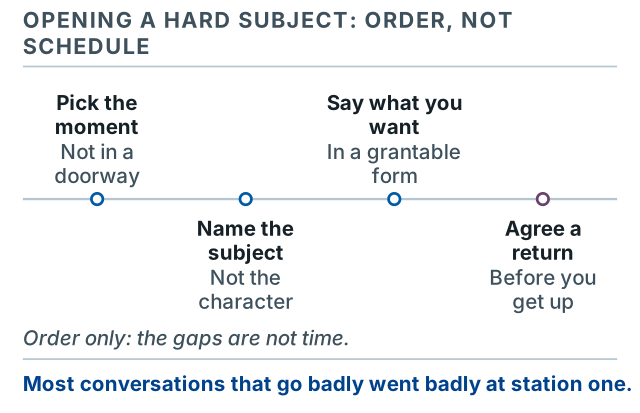
Say what happened, say what you felt, say what you want — in that order, briefly, at an hour when nobody is trying to sleep. The opening minute does more work than anything that follows, because it decides whether your spouse is listening to a problem or answering a charge about who they are.
Three things make an opening land badly regardless of how reasonable the underlying complaint is: a summary word (always, never, every time), a diagnosis of the other person’s motives, and an audience — children, family, anyone on the other end of a speakerphone. Take those out and what is left is answerable.
| What it sounds like | What your spouse hears | The same thing, opened differently |
|---|---|---|
| You never help with the house. | A verdict on who I am. The only reply is a list of things I did do. | The kitchen was still full when I got in on Tuesday, and I was too tired to face it. Can we split the evenings? |
| You always put your family first. | An accusation about loyalty, which is bigger than the actual weekend. | The last few Sundays have gone to your parents. I'd like the coming one to be ours. |
| Why are you being so difficult about money? | That I'm the problem, so I'd better prove I'm not. | The card statement surprised me and I got sharp about it. Can we look at it together on Sunday? |
| We need to talk. | Something is wrong and I have the rest of the day to imagine what. | There's one thing about the holiday I want to sort out. Tonight or tomorrow — which suits you? |
| Fine. Do what you want. | The subject is closed and I have lost, so I will bring it back later, worse. | I'm not up for this right now. Can we come back to it after the kids are down? |
The receiving side has an opening minute too. When something is raised about you, the first sentence out of your mouth decides the next hour: a question about what happened keeps it a conversation, while a counter-complaint turns it into a trade. Holding your own grievance for another day is not weakness. It is the only way either subject gets a fair hearing, and the couples who do it are not calmer people — they have simply agreed that two complaints at once produce nothing.
Timing is a large part of it. A subject raised while someone is walking through the door, mid-task, or already annoyed about something else gets the answer the moment deserves rather than the answer the subject deserves. Asking when is a good time is not avoidance; it is the difference between a conversation and an ambush.
The other part is scope. Decide before you open it whether you want a decision, a change, or simply to be heard — and then say which. A spouse who thinks they are being asked to fix something will start proposing solutions to a person who only wanted the day acknowledged, and both of you will leave the room annoyed for reasons neither of you named.
Where the subject is really about an arrangement — who does what, what is shared, what either of you can decide alone — the conversation belongs in the language of agreements rather than complaints. That is a distinct skill, and it has its own page on boundaries in marriage.
The opening minute, on one page
That did not go through. Nothing was saved and nothing was sent. Try the address again, or write to us directly and we will add you by hand.
- What arrives
- One question worth asking your spouse this week, and the shortest honest account of when it works.
- What does not
- No rules with numbers in them, no promises about outcomes, and no third party ever gets the address.
How do you stop an argument escalating?
Stop talking before you have said the thing you will have to apologise for, and name a time to come back. That is the whole technique. The subject is not what escalates an argument. Both people have gone past the point where they can take anything in, and neither one has a way to call it.
There is a physical reason the middle of a bad argument feels the way it does. Levenson and Gottman’s early work on physiological arousal during conflict described how a heated discussion registers in the body — heart rate, the sense of being swamped — and how what someone can take in narrows while that is happening. Stated qualitatively, and that is the only way it should be stated: a person in that state is not stubbornly refusing your point. They have limited access to it.
Which is why let’s just finish this now is the worst available idea. Finishing it now means continuing a conversation with someone who cannot process it, and the sentences produced in that stretch are the ones that get quoted back years later.
A pause that works has three parts, and the last is the one people skip:
- A signal either of you can use. Not a punishment and not a slammed door. A plain sentence — I need a bit of time — that both of you agreed in advance would be respected. Imagine agreeing to it on a calm Sunday rather than inventing it mid-argument; that is the only time the agreement is negotiable.
- A real break. Away from the room, doing something that is not rehearsing your closing statement. The break is for calming down, not for building a better case.
- A named return. After dinner. Tomorrow morning. Without it, the pause is just the argument going underground, and the person who wanted to talk learns that pauses mean abandonment.
Couples who ask how to stop arguing with their spouse are asking about something narrower than disagreement itself: the same fight running on a loop, month after month. The loop is made of three habits: opening with a verdict, adding subjects mid-argument, and never returning to anything once it cools. Fix the return and the loop loses most of its fuel, because the argument no longer has to carry every unfinished conversation of the last month.
It also helps to know which arguments are not going to end. Some of what any couple disagrees about is permanent — differences in temperament, tidiness, how much family contact feels right, how money should feel rather than what it should do. Those are managed, not solved, and treating them as solvable is what turns an ordinary difference into a recurring fight. The practical version: when a subject keeps coming back, stop looking for the answer and start looking for the arrangement both of you can live with until circumstances change.
One more thing belongs here plainly. Nothing on this page addresses situations where anyone at home is frightened or unsafe. That is not a communication problem and it is outside what an editorial guide should touch — it belongs with a professional in the relevant field, and our sources and further reading page points at where that route starts.
What do you do when you have stopped talking altogether?
Start smaller than the problem. Couples who have gone quiet reach first for the biggest unresolved subject, which is the one conversation neither of them can currently hold, and the failure confirms to both that talking is pointless.
Silence between spouses is not a decision. It accumulates. A subject goes badly, so it gets avoided; avoiding it means avoiding the neighbouring subjects; after a while the only safe territory is logistics — bins, bills, pick-up times — and the house sounds like a shared office.
The way back runs through low-stakes contact first, and it is slower than anyone wants:
- For example, a short conversation about something neither of you has a stake in — a programme, a friend’s news, a plan for the summer — is not avoidance. It is re-establishing that talking to each other is survivable.
- For instance, a standing time works better than good intentions. The same slot on the same evening, phones face down, no agenda except being in the same room and awake.
- Consider using written words if speaking has become loaded. A note that says I miss how we used to talk and I don’t know how to start does something a face-to-face opening cannot, because neither of you has to manage your expression while it is being read.
Only after that does the parked subject come back — announced in advance, with a time attached, and with the smallest version of it opened first. If a long stretch of trying has changed nothing, the next step worth taking is a qualified professional rather than another article. That is a normal thing for couples to do, and it is not a verdict on the marriage.
What is worth talking about when nothing is wrong?
The ordinary maintenance conversations: what each of you is worried about this month, what is coming up, what the two of you are looking forward to, and what has changed since the last time either of you asked. Couples who only talk when something is wrong end up with a marriage in which talking means trouble, and the arrival of a conversation is itself alarming.
The point of talking when nothing is wrong is not intimacy in the greeting-card sense. It is maintenance of information. People change quietly — what they want from work, what they find tiring, what they have quietly given up on — and a spouse who last updated their picture years ago will keep responding to a person who is no longer quite there.
A handful of subjects are worth a regular airing, and none of them requires a special occasion. What is loading each of you right now. What is coming in the next few weeks that needs both of you. What either of you is looking forward to. And one thing you noticed and appreciated recently, said out loud, because the noticing does nothing while it stays internal.
A weekly version of this takes less time than an argument and prevents some of them. Same evening, kettle on, a short list: what is coming up, what is bothering either of us while it is still small, and one thing to look forward to. Keep it short enough that neither of you dreads it, and hold it even in the weeks when there is nothing to report — a check-in that only happens when something is wrong becomes another way of announcing trouble.
The one rule that makes it survive is that nothing raised there gets punished. If a small irritation named at the kettle turns into a long row, nobody will name a small irritation again, and the whole habit collapses back into logistics.
If starting from nothing feels artificial, a prompt is a legitimate crutch — we keep a library of them on questions to ask your spouse. Reading a question off a page is not less genuine than inventing one; it just removes the part where somebody has to think of a subject at the end of a long day.
What this page does not do
Communication advice attracts more invented certainty than almost any other marriage subject. Here is what we leave out on purpose.
- We do not print folk statistics about arguing
- How many arguments a healthy couple has, what share of disagreements can never be settled, how long couples wait before getting help — those numbers circulate everywhere and do not survive checking. No figure appears on this page.
- We do not sell a protocol
- There is no certified method behind this site, no script to memorise and no sequence of steps that resolves a marriage. What is here are habits, described plainly, that you can try and drop.
- We do not write lines for you to use on your spouse
- Nothing here is a manoeuvre to be performed on somebody who has not agreed to it. The habits are for the person reading them, and a sentence deployed as a technique gets heard as one.
- We do not predict what your marriage will do
- A page cannot see your kitchen. Anything framed as a sign of where a marriage is heading is a guess wearing confident clothes, and we would rather leave the space empty.
- We do not cover situations involving fear or safety
- If anyone at home is afraid, that is not a communication problem and this is not the right kind of page. It belongs with professionals, and our sources page is where that route starts.
Our own view, stated once: the habits on this page are undramatic, and that is the argument for them. Not one of these habits needs a vocabulary, a course, or your spouse’s agreement before you can try it, and every one of them is visible to the other person inside a week. That combination is rarer in marriage advice than it sounds. The wider picture of what holds a marriage together sits on our main guide, and the works we refer to are listed on sources.
Checked: 2026-09.