Marriage advice for newlyweds is the small set of decisions a couple makes early about money, housework, time and family — the arrangements that would otherwise be settled by habit, by whoever minds least, or by whoever gives way first. It is not about romance, and it is not a warning. It is the paperwork of ordinary life, done while it is still cheap to change.
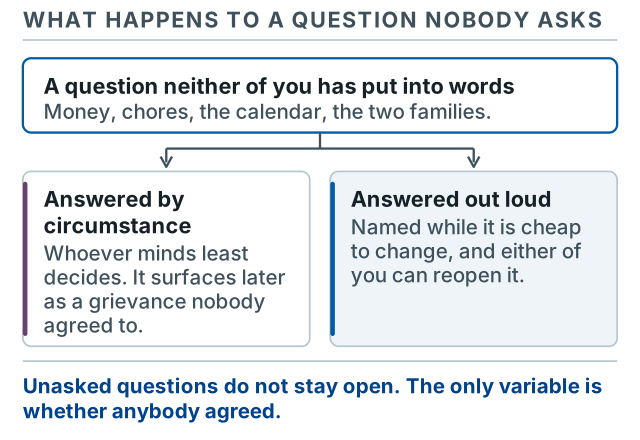
The wedding gets planned in detail. The week after it gets none of that attention, and that is the week the defaults begin forming: which of you answers the landlord, whose diary the weekend is planned around, who notices that the washing-up liquid has run out. Nobody decides any of this. It settles. This page is about which of those settlements are worth making deliberately, and which ones never needed a conversation in the first place. The wider view of what helps a marriage sits on our main guide.
What changes in the first year of marriage?
Less than newlyweds expect emotionally and more than they expect administratively. Feelings carry on much as they did the month before the wedding. What changes is that a couple now shares a set of standing arrangements — accounts, a calendar, a household, families on both sides with expectations — and each of those arrangements gets an answer whether or not it was ever discussed.
Some couples who lived together beforehand say the first year felt like nothing changed, then find a subject that behaves differently anyway: relatives who now assume a claim on holidays, money that is now described as ours in conversation but split as mine in practice, or a sudden awareness of the future as a shared object rather than a private one each. The change is less a feeling than a shift in who has standing to ask about what.
A note on the version of this advice aimed at one half of a couple. What circulates as marriage advice for the bride, or for the groom, tends to be instruction in absorbing friction quietly: be patient, be easy to live with, pick your battles until there are none left. Advice that only one person can follow is not advice about a marriage. Anything on this page that would stop working if both of you did it has been left out.
There is a second change that gets little attention: the audience. Before the wedding, an argument was private business between partners. After it, both families, and sometimes a group of friends, have opinions about how the marriage is going and feel entitled to share them. Deciding early how much of your life is reported outward saves friction later.
- For example, a couple who always split restaurant bills keeps doing it out of habit, then one of them gets a pay rise and the habit starts to feel either mean or patronising depending on which side of the table you sit. Nothing was decided; a default simply expired.
- For example, one partner’s mother phones on Sunday evenings and stays on the line a long while. That was a fact of one person’s life before the wedding. It is now a fact of both, and neither of them has ever said out loud whether Sunday evening belongs to the household or to the phone.
Which defaults are worth setting on purpose?
A short list is worth an actual conversation: money, the household, the calendar, and families. Everything else can be left to sort itself out. The test for whether a default deserves a conversation is simple — if getting it wrong produces a recurring irritation rather than a one-off inconvenience, it is worth naming now.
The table below is the short version of a first-year checklist. The left column is the subject; the middle column is what happens if nobody raises it; the right column is the conversation that resets it. None of these need to be settled permanently. They need to be said once, on purpose, with both people awake.
| Area | The default that sets itself | The conversation that resets it |
|---|---|---|
| Money | Whoever is more relaxed about spending sets the pace; whoever pays the bills quietly gains the deciding vote | What is joint, what stays personal, and the size of purchase either of us mentions first |
| The household | The person who notices mess first ends up owning it, and stops being thanked for it | Who owns which recurring task, and what standard counts as done |
| The calendar | Work fills the week; friends and relatives fill what is left; whatever remains is what the marriage gets | Which evenings are protected, and who has permission to give them away |
| Families | The family that asks loudest gets the holidays and the news | Where the significant dates are spent, and how much either family is told about our money and our arguments |
| How we argue | The pattern of the first bad week becomes the pattern | What each of us needs mid-argument: a pause, a plainer sentence, or a return time |
Two of those columns collect quiet resentment, which is why they deserve extra care. The household is one: the labour of noticing what needs doing is invisible, unpaid, and hard to count as work from the outside, since the only visible trace of it is that nothing went wrong. Money is the other place it collects, and it has a longer treatment on our page about budgeting for couples, including how to hold the monthly conversation before there is anything wrong to discuss.
- For instance, “we’ll split things fairly” sounds settled and is not. Fairly by half, by income, or by who uses more? Say which one, out loud, and name the size of purchase either of you would mention first.
- For instance, “of course we’ll see both families at Christmas” holds for exactly as long as the families live in the same city. The version that survives is duller and more useful: which set of dates, in which years, decided by when.
The first-year check-in, by email
That did not go through. Nothing was saved and nothing was sent. Try the address again, or write to us directly and we will add you by hand.
- What arrives
- One question worth asking your spouse this week, and the shortest honest account of when it works.
- What does not
- No rules with numbers in them, no promises about outcomes, and no third party ever gets the address.
Where these arrangements are worth writing down, write them as agreements between equals rather than rules one person issues — which is the subject of our page on boundaries in marriage. The difference is audible from across the room: an agreement says we decided, a rule says you must, and the second kind gets tested soon after.
What do newlyweds argue about, and why is that normal?
Chores, money, time with relatives, and how much of a week work is allowed to take. Those are the recurring subjects, and the presence of arguments is not evidence that something has gone wrong. Partners who lived by different standards until now are merging them; the merge produces noise even when both of them are being reasonable.
What matters is less the frequency of arguments than their shape. Arguments that name a specific thing, end somewhere, and can be raised again next month are ordinary maintenance. Arguments that restart from the beginning every time, or that stop being possible at all, are the ones worth paying attention to.
Also worth knowing early: not every disagreement is going to be solved. John Gottman and Nan Silver’s The Seven Principles for Making Marriage Work — a book we cite and have no connection to — treats part of what couples argue about as perennial: differences in temperament, tidiness, sociability, appetite for risk, where the workable goal is a conversation you can keep having rather than a verdict to reach. We set out that framework in our own words on the seven principles, and how we read the works we cite is on our sources page.
Consider a couple arguing about the dishwasher again this week. The dishwasher is not the dispute. The dispute is that one of them believes tasks belong to whoever sees them and the other believes tasks belong to whoever agreed to them, and neither has ever said that sentence aloud. Once it is said, the argument becomes a scheduling problem, which is a much smaller thing to have on a Wednesday.
Some habits keep first-year arguments the ordinary kind. Raise the subject while it is still small enough to sound petty, because the petty version is the honest one. Make a request rather than a case — what you want next time, not a history of what happened. And let a subject be parked rather than won, with an actual date to come back to it, when both of you are too tired to be fair.
If a subject cannot be raised at all for a long stretch, or if any question of safety is involved, that belongs with a professional in the relevant field rather than with a guide like this one; we do not cover that subject anywhere on this site, and the route to people who do is on our sources page.
Which habits are worth starting now rather than later?
Start with a short recurring check-in about the household and the calendar, plus a longer money conversation on a fixed date. Both are dull by design. They work because they exist before there is a grievance to schedule them around, which means neither of you has to escalate to get a subject onto the table.
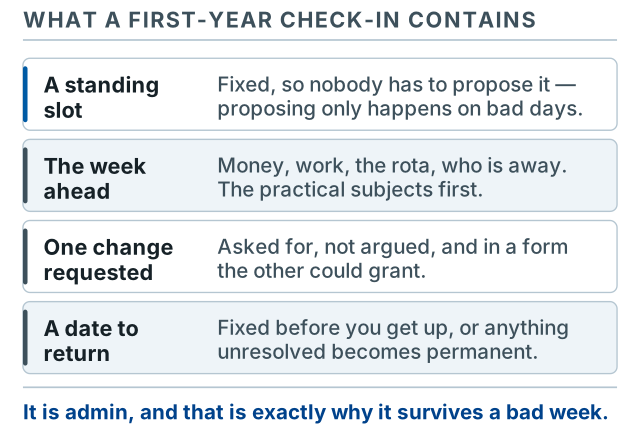
Keep the check-in short and practical. What is coming up, what needs money, what needs a decision, and something either of you would like different. It is not a place to review the marriage, and it works better if it never becomes one — the moment it turns into an assessment, both of you will start finding reasons to skip it.
- For example, a couple keeps theirs to the walk back from the supermarket on a Saturday: bags in hand, no table, no eye contact, which is exactly why the awkward items get said.
- For example, a money conversation set for the same date each month means neither of you has to open with “we need to talk about money” — the worst opening sentence in a marriage, because it announces a trial before anyone has said what happened.
Lighter habits are worth adding once the practical ones are running. Keep asking each other questions that are not logistics, because a first year is unusually good at filling every conversation with admin. And repeat, occasionally, the questions you asked each other before the wedding: those answers were predictions, and now you have evidence. Our questions to ask before getting married set works as well after the wedding as before it, with the added advantage that nothing is riding on the answers any more.
Another habit is worth naming because it is the first to be dropped when a first year gets busy: keeping some part of the week that is neither work nor housework nor family. An evening out, a walk, a shared programme watched badly with a phone in hand — the content matters less than the fact that it is recurring and that neither of you has to propose it each time. Couples who lose this may not notice at the time; they simply find, some way in, that every conversation they have is a handover of tasks, and that they have become efficient colleagues running the same flat.
The other thing to protect is a tolerance for the other person being unlike you. A first year puts different habits of living under one roof, and the pressure to converge is quiet but constant: same bedtime, same tidiness, same appetite for company. Some of that convergence is genuinely easier. Some of it is one person disappearing to keep the peace, which costs more later than any argument about the dishwasher.
A note on advice from other people, which arrives freely in a first year and describes the marriage of whoever is giving it. Take the specific and leave the general: how someone runs their holidays is useful, whether they think you should share an account is not. The same test applies to this page.
What this page does not do
First-year advice is a set of arrangements, not a forecast about how a marriage will go.
- We do not predict how your marriage will turn out
- Nothing here reads as a sign, a stage or a warning. A page cannot see your marriage, and any guide that claims to know where a first year is heading is selling certainty it does not have.
- We do not print folk statistics about the first year
- Which year is hardest, how often couples ought to argue, what money is said to do to a marriage — none of it appears here, because none of it survives checking. The absence is deliberate.
- We do not cover the wedding
- Name changes, paperwork, seating plans and thank-you cards are logistics with better guides elsewhere. This page starts the week the guests go home.
- We do not offer therapy
- There is no programme, no protocol and no counselling behind this site. A subject that needs a room and a professional in the relevant field is a different thing from a guide like this one, and we would rather say so than blur the line.
Checked: 2026-09.