A boundary in marriage is a stated limit on your own behaviour — what you will do, and under what conditions — held inside an agreement two people made as equals. Popular advice about boundaries in marriage quietly turns the word into something else: a rule handed to a spouse, with a consequence attached. That version is an ultimatum wearing a calmer vocabulary, and it tends to produce the standoff it was meant to prevent.
The distinction sounds like hair-splitting until you use it in a real kitchen at a real hour. Phrase the limit the first way and the evening still has somewhere to go: your spouse can agree, object, or put something else on the table, and the subject is available again on Sunday. Phrase it the second way and there are two exits, both bad, and whichever one gets taken becomes the thing you are arguing about next.
This page covers the areas where agreements get written — time, phones, relatives, money, household work — how to phrase one so it can actually be kept, and what to do when one is ignored. The wording of the conversation itself lives in our guide to communicating with your spouse; the money version is worked through in budgeting for couples. The rest of the guide starts on the main marriage advice page.
What is a boundary in a marriage?
A boundary is a limit you set on your own conduct and announce in advance, so your spouse can plan around it. It answers one question: what will you do, under what conditions. An ultimatum answers a different one: what must your spouse stop, or else. The first can be kept by the person who said it; the second requires obedience.
That difference decides how the sentence lands. “Stop taking work calls at dinner or I am done” puts your spouse in a corner with two exits, both bad. “I am going to sit down to dinner at the usual hour whether or not the call is finished, and I would rather we ate together” states your own move and leaves the room open. Neither sentence guarantees anything. Only one of them can survive the evening your spouse says no.
Boundaries also get confused with preferences. A preference is something you would like; a boundary is something you have decided to do about it. Wanting your mother-in-law to call before visiting is a preference. Deciding that you will answer the door in whatever state the house is in, and not spend the afternoon apologising for it, is a boundary. The preference is worth raising anyway — a marriage where only decided things get said is a quiet one.
Two more things a boundary is not. It is not a punishment with a softer name: if the sentence exists mainly to make your spouse feel a cost, it is a consequence, and consequences belong to courts and workplaces rather than to a marriage. And it is not a diagnosis. Nothing on this page is a way to work out what kind of person you married; it is a way to work out what you have both agreed to.
There is another confusion worth clearing, because it quietly costs couples time: the belief that needing an agreement at all is a sign something is wrong. Two adults who grew up in different households will disagree about when a house is clean, how late is late, and what counts as telling someone. Writing an agreement is not evidence of a problem. It is the ordinary work of merging two sets of unstated rules, and it goes on for as long as the marriage does, because the rules keep changing under you: a new job, a baby, an ill parent, a move.
- For example, a plain boundary sounds like this: “I am not going to discuss the credit card late at night. I will bring it up on Saturday morning instead.” One person can keep that sentence alone.
- For example, the same wish as an ultimatum sounds like this: “If you bring up the credit card at night again, I am sleeping downstairs.” Now the sentence needs a second person to perform, and a punishment attached to it to mean anything.
Which boundaries do couples actually need?
The agreements that end up carrying weight sit in ordinary areas: time, privacy, extended family, money, and household work. The list is unremarkable, which is the point — friction does not wait for the grand questions a wedding planner asks about. It arrives on a Tuesday, about a phone, a visit or a shopping list. The grand questions get settled once, in an atmosphere of goodwill; these come back every week in whatever mood the week supplies, which is what makes them worth wording in advance.
The table below is a starting shape, not a standard. Copy the left column, throw out the wording, and write your own version out loud with your spouse. The right-hand column is the part worth checking hardest, because it is the part that does not depend on anyone else’s cooperation.
| Area | What it sounds like as an agreement | The part one person can keep alone |
|---|---|---|
| Time | "Weeknights after dinner are ours unless we agree otherwise in advance." | You put your own laptop away at that hour, whether or not theirs is open. |
| Phones and privacy | "Phones stay off the table at meals. Neither of us reads the other's messages." | You leave yours in the other room and you do not read theirs, full stop. |
| Extended family | "Visits get agreed by both of us before anyone is invited." | You stop confirming plans on your family's behalf until you have asked. |
| Money | "Anything above a spending line we set together gets mentioned first." | You mention yours first, every time, starting now. |
| Household work | "Whoever cooks does not clear up. Sunday evening we redo the list." | You do your half of the split even in a week when theirs slips. |
Privacy is easy to argue in the wrong register. Reading a spouse’s messages gets defended as openness and received as surveillance, and once that has happened the argument moves onto the reading itself and leaves whatever prompted it unexamined. An agreement handles it better than a discovery does: decide together what is shared, what is not, and what either of you would want told outright rather than found.
Extended family is the other place agreements get tested early in a marriage, because both of you arrive with a household you have already lived in and rules you never had to state. Whose Christmas, whose emergencies, how much financial help travels back and forth, who gets told family news first. None of that is obvious, and treating it as obvious is how couples end up having the same argument again and again.
- For example, a time boundary about working hours: “I will leave the office at the agreed hour on Wednesdays. If a meeting runs, I say so in the afternoon so you are not holding dinner.” It is specific, it names the failure case, and the person who said it is the person who executes it.
How do you state a boundary so it can be kept?
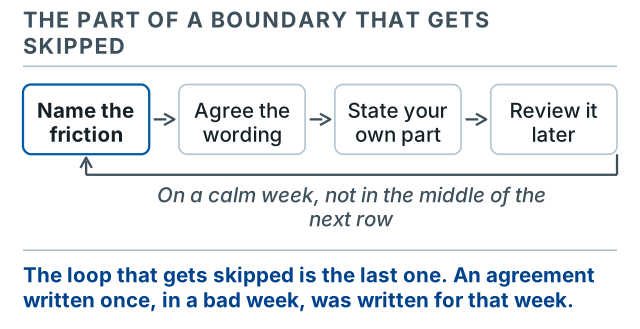
State it in calm hours, in the first person, about one situation, with the failure case named. A sentence that meets those tests can be kept by you alone, which is the only kind that holds. Sentences that begin with the word “you” tend to turn into an argument about whether the description of your spouse is fair, and the original subject disappears.
The timing matters more than the phrasing. A boundary announced mid-argument reads as a weapon drawn, no matter how carefully it is worded — and in Levenson and Gottman’s early research on physiological arousal during conflict, what happens to the body during a heated exchange is bound up with how couples fare afterwards. The plain version for a kitchen: nobody is at their most reasonable while their heart is pounding. Raise the subject on a walk, on a Saturday, in a car.
One situation at a time. “I need you to respect me” cannot be kept by anyone, because respect is a summary of small daily behaviours, and each spouse is summarising a different set of them. “I would like to be asked before we commit to a weekend at your parents’ place” is a single event with a single test. The general version feels braver to say and gives your spouse nothing to do.
Name the failure case out loud, because it will happen. What do you do the evening the agreement is broken by accident? A boundary with an unspoken consequence is a trap: your spouse walks into it, you enforce something never discussed, and the argument moves on to the enforcement. Better to say the whole thing at once: here is the agreement, here is what I will do when it slips, and here is what I would like you to do.
And say what the boundary is for. Standing agreements in a marriage are not paperwork; they are how two people protect the parts of the week they want to keep. That framing runs through Gottman and Silver’s practical guide for couples, which writes about building shared rituals and agreed roles rather than about winning disputes; our own walk through the seven principles for making marriage work sits on its own page. A rule with a reason attached gets kept; a rule handed over on its own gets tested.
One honest letter when a new part of this guide is published
That did not go through. Nothing was saved and nothing was sent. Try the address again, or write to us directly and we will add you by hand.
- What arrives
- One question worth asking your spouse this week, and the shortest honest account of when it works.
- What does not
- No rules with numbers in them, no promises about outcomes, and no third party ever gets the address.
What do you do when a boundary is ignored?
Raise the specific event, once, close to when it happened, and check whether the agreement was ever really made. A boundary that gets “ignored” may never have been agreed in the first place: one spouse announced a rule, the other said nothing, and silence got recorded as consent. That is worth ruling out before anything else, because the repair for it is a conversation, not a consequence.
If the agreement was real, describe the event rather than the pattern. “The plumber came on Thursday and I found out from your mother” gives your spouse something to answer. “You never tell me anything” invites a defence of the whole marriage, and you will spend the evening trading counter-examples. Description first, request second, and stop talking.
Then keep your own half, especially in the week it is least deserved. This is the unglamorous part. If the agreement was that whoever cooks does not clear up, and your spouse left the pans on Wednesday, doing your half on Thursday is not weakness — it is the only thing that keeps the agreement alive long enough to be renegotiated. Matching a slip with a slip converts an agreement into a scoreboard quickly.
When the same boundary slips repeatedly, treat it as information about the agreement rather than about your spouse’s character. Consider a couple who agreed that neither would confirm weekend plans alone, and who broke it on repeated weekends: the more useful reading is that the rule does not fit their actual life, rather than that either of them stopped caring. Redraft it. An agreement that keeps failing is a draft, and drafts are supposed to be rewritten.
It also helps to separate the slip from the meaning you attached to it. A missed agreement about the dishwasher is not really a claim about the dishwasher; what is being asked is whether the week is being shared fairly, and that is the sentence worth saying out loud. Consider a spouse who has raised the same point on consecutive evenings about different objects — the plates, the school run, the unanswered message. The objects are decoys. Naming the underlying subject once, calmly, spares you the next round of arguments about crockery.
Two honest limits. Escalating — louder statements, bigger consequences, an announcement that this is the last time — buys the next conversation nothing and costs it a good deal, and there is no version of this page that will change a spouse who is not part of the conversation. And where a boundary is about your physical safety, that is not a subject for an article; it belongs with people whose field it actually is, and the routes to them are listed on our sources page. Where resentment has already settled in and the agreements feel pointless, the ground is different, and we cover it separately in what to do when you hate your spouse.
What does respect look like day to day?
Day to day, respect in a marriage is a logistical thing: being told about matters before they are decided, being asked rather than informed, having your no accepted the first time. It is noticeable in ordinary weeks, in the size of decisions each spouse makes alone, and in whether requests get an answer rather than a shrug.
Respecting your spouse is easier to check as behaviour than to feel as an attitude. Do plans that affect both of you get mentioned before they are settled? Does a stated limit hold the next time, or does it need to be argued again from scratch? Are their preferences described to other people the way they would describe them? None of that requires warmth on any given Tuesday. It requires the habit of treating the other person as a party to the decision.
Anyone searching for signs a spouse does not respect them has particular evenings in mind, and the useful move is to keep them particular. Behaviour that is worth raising: decisions you learn about afterwards, requests met with jokes when you were serious, agreements that only ever get renegotiated in the moment. Raise those as events. What is not useful is converting a list of events into a label for the person you married — labels end the conversation, and you still have to live in the same house on Friday.
- For example, a specific version sounds like this: “You booked the holiday dates without telling me, and I found out when the confirmation came through. I would like to be asked before dates are settled.” One evening, one request, no verdict.
Respect also runs downhill from small things. Answering the question that was asked. Not finishing their sentences in company. Saying what you actually think rather than agreeing now and resenting it later — quiet compliance is not respect, and both of you can feel the difference. A marriage where boundaries hold is, in the end, a marriage where these unremarkable habits run quietly enough in the background that nobody has to demand them.
What this page does not do
This is an editorial page about agreements between spouses. Its limits are worth stating plainly.
- Read your spouse from a broken agreement
- This page is about wording and agreements, not about assessment. An agreement that keeps failing tells you something about the agreement. It is not evidence about the character of the person on the other side of it, and we do not supply a scale for converting one into the other.
- Give you a script that always works
- Wording changes the odds of a conversation going well. It does not decide the outcome, and any page promising that it does is selling something.
- Set a standard for a normal marriage
- The table is a place to start a conversation, not a list of agreements a marriage is supposed to hold. A household that runs its week on fewer stated rules is not behind on anything.
- Replace a professional
- Where the same agreement keeps failing over a long stretch, or where a boundary is about safety, that is work for a professional in the relevant field, not for a guide like this one. We take no fee for saying so, and nothing here is routed to anyone who does.
Boundaries in marriage work best when they are boring: named early, phrased in the first person, reviewed when life changes, and kept by the person who set them even in a bad week. The books and research we draw on are listed, with notes on how we read them, on our sources page. This is an independent editorial guide with no affiliation to any of them.