Money guides for couples open with a category list, as though the hard part were addition. It is not. Budgeting for couples is the practice of settling the arrangement first — the structure that decides which money is shared and who can spend what without asking — and then letting a spreadsheet follow it rather than lead it. Two people can agree on every figure and still argue every Saturday. This page covers the shapes couples use, what belongs in a joint pot, how a monthly money conversation runs, and the places these arrangements break. Checked: 2026-09.
How should couples budget together?
Pick a structure first, then a method, because the structure is what you will argue about. Couples choose among three shapes: everything joint, everything separate, or a hybrid where shared costs are paid from a common pot and each person keeps money that needs no explanation. A method — envelopes, an app, a shared sheet, a standing transfer — sits on top of whichever shape you chose, and any of them works once the shape is settled.
The reason structure comes first is that the thing being argued about is not the amount but whether the purchase needed permission — and permission is a property of the structure, not of the receipt. Two people who have never named which pot pays for a birthday present can end up relitigating that present each time it comes round.
| Model | Who it suits | Where it breaks |
|---|---|---|
| Everything joint | Similar earnings, similar spending habits, a shared long view; couples who dislike bookkeeping | Small personal spending starts to feel supervised; gifts and surprises are awkward; a big income gap can turn every purchase into a comparison |
| Everything separate | Partners who came in with established finances, different obligations, or a strong wish for autonomy | Shared costs get negotiated repeatedly; the lower earner quietly absorbs more; nobody has a view of the whole picture |
| Hybrid: shared pot plus personal money | Couples with unequal incomes or different spending styles; anyone who wants both a joint plan and unsupervised coffee | Only works if the contribution rule and the no-questions threshold are named; unnamed edge cases fall back into argument |
Choosing is less momentous than it sounds, because the choice is reversible. Couples move between these shapes as circumstances change: a baby, a career break, one person going freelance, a parent needing help. What causes trouble is drifting between them without saying so — running a joint life on separate accounts, or a separate life out of a joint one.
- For example, a couple who both salary in on the same date might set one standing transfer into a joint account on payday, leave what remains as personal money, and never discuss groceries again.
- For instance, a pair with an unpredictable freelance income might agree a percentage rather than a fixed sum, so the lean months adjust themselves without a new conversation each time.
- Consider a couple where one partner earns considerably more: they can size the joint pot by what the shared life costs, split the contributions proportionally, and keep personal money equal in principle rather than in amount.
Whichever shape you choose, write it down somewhere both of you can see it. Not for bookkeeping — for memory. An agreement that lives only in two heads gets remembered in two different versions, and the difference surfaces at the till.
What belongs in a joint pot and what does not?
Shared costs belong in the joint pot; personal costs belong to the person; the argument is about the edge cases, so name them in advance. Rent, utilities, food, insurance, the car that carries both of you, the children’s costs — the shared label on those is obvious. The fights live in a narrow band of items that are technically personal but socially shared, or technically shared but enjoyed unequally.
The useful move is to make a short list of edge cases while nothing is at stake, and rule on each one. The classic band includes gifts for each other, gifts for family, haircuts and grooming, one partner’s expensive hobby, one partner’s commuting costs, subscriptions that only one person watches, meals out with friends, and the annual sting of a car service or a dental bill.
You do not need a principle that covers every future case. You need a decision on the cases you already know about, and a habit of adding new ones as they appear. This is where budgeting overlaps with boundaries in marriage: a spending threshold is an agreement between equals about when to consult, not a permission system one person administers for the other.
A second thing worth naming is the no-questions amount — the size of purchase either of you can make without a heads-up. Skip it, and each of you carries a different unwritten rule, which is how one person can end up feeling policed and the other blindsided by the same transaction.
Get the monthly money check-in agenda
That did not go through. Nothing was saved and nothing was sent. Try the address again, or write to us directly and we will add you by hand.
- What arrives
- One question worth asking your spouse this week, and the shortest honest account of when it works.
- What does not
- No rules with numbers in them, no promises about outcomes, and no third party ever gets the address.
How do you run a monthly money conversation?
Short, scheduled, with an agenda both of you saw beforehand, and away from the moment of purchase. A money check-in is a standing conversation about the arrangement — what came in, what went out, what is coming, and whether any rule needs changing — held on a fixed date rather than triggered by a bad statement. The point is that it happens when nothing is wrong, so that when something is wrong it has somewhere to go.
A workable agenda is short enough to hold in your head. What came in and what went out since last time. Anything unusual coming up before the next check-in. Any edge case that came up and needs a ruling. Anything either of you wants to save toward. And one question that is not about arithmetic: is anything about the current arrangement quietly annoying you?
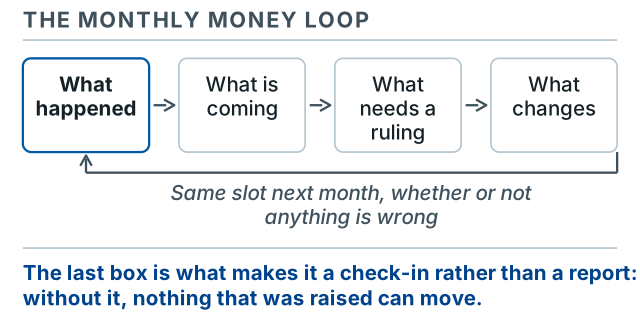
Timing matters more than technique. Late at night, immediately after a card is declined, or while one of you is cooking are all bad slots. A weekend morning with coffee, a calendar entry neither of you has to propose each time, and a clear end — the check-in is over when the agenda is done, not when someone concedes.
Two small rules keep it from turning into an audit. The first: whoever is more comfortable with the numbers prepares them, but does not present them as a verdict. The second: nothing on the list is a surprise. If one of you has something heavy to raise, say so when the check-in is scheduled, so the other arrives ready rather than ambushed. A check-in can be easier to start than to maintain, particularly in a first year; if that is where you are, the habits worth building early are in our guide for newlyweds.
How do you talk about money without it becoming a fight?
Talk about the arrangement, not the last purchase, and do it at a time neither of you chose in anger. A money row can be a rule dispute wearing the costume of a transaction. The jacket, the takeaway, the impulse upgrade — each can become a proxy for a question nobody has answered: what may either of us do without checking first?
That is why the phrasing that travels is structural. “Can we set a number above which we give each other a heads-up?” travels much further than “you spent how much?” The first invites a rule; the second invites a defence. The general mechanics of staying out of that spiral — picking the moment, describing rather than judging, pausing when the conversation heats up — are covered in how to communicate better with your spouse.
- Imagine one partner saying, over Saturday coffee, “I noticed I felt tense about the delivery orders last month. I don’t think you did anything wrong, I think our rule is out of date.” That sentence is about the rule, and it is answerable.
There is also a physical layer to this, and it is worth saying plainly. Conflict about money raises the temperature in the same way other conflict does; the body reacts before the argument is settled, which is the phenomenon studied in Levenson and Gottman’s work on physiological arousal during conflict. We describe that research qualitatively and keep figures off this site by policy — the reasoning is on our sources page. The practical read: if either of you is too heated to hear a sentence through, the check-in is finished for today and resumes at a stated time.
One more distinction is worth holding. Some money disagreements are solvable — a rule is missing, you write one, it is done. Others are perpetual, rooted in how each of you was raised around money and unlikely to be settled at a kitchen table. The split between solvable and perpetual conflict is borrowed language: it comes from The Seven Principles for Making Marriage Work by John Gottman and Nan Silver, which we walk through on our seven principles page. We have no connection to the authors, and nobody pays us to name the book. A perpetual difference is managed with a workable arrangement, not eliminated by a better spreadsheet.
Where do couple budgets break?
Budgets break at unequal incomes, at unnamed edge cases, at spending that stops being mentioned, and at reviews that only happen after something has gone wrong. The arithmetic is not the part that gives way. What fails is the agreement quietly going out of date while both people carry on behaving as though it holds.
Unequal incomes. An equal split feels fair on paper and lands unequally at home: the same sum is a rounding error for one partner and a real constraint for the other. One way through is to stop splitting the bill and start sizing the joint pot to what the shared life costs, then contribute proportionally. The harder part is symbolic. The lower earner needs money that requires no explanation, or the arrangement turns into an allowance, however kindly meant.
Unnamed edge cases. Look under a recurring row and there is an unwritten rule. Whose budget pays for the visiting family, the gym neither of you uses, the professional course, the car repair. Add each one to the list as it appears; a ruling made once at a calm moment costs less than an argument that keeps coming back.
Spending that goes unmentioned. Not deception on a grand scale — the ordinary version is a purchase not brought up because the last one drew a comment. Worth noticing, because the cost is not the money. It is that the arrangement has stopped describing what actually happens, and both people are now budgeting against a fiction. The repair is a rule change, not a confession: if the current threshold is unlivable, it is the wrong threshold.
Reviews that only happen in a crisis. If the only time you look at the numbers together is after a shortfall, then money arrives attached to bad news, and the subject becomes easy to avoid. A dull scheduled check-in is what prevents this, and dullness is the point.
Life events nobody re-budgeted for. A new job, a baby, a move, a career break, one partner supporting a parent. The old arrangement may not survive these intact, and it does not announce its failure. Treat any of them as a prompt to re-open the structure question — the shape that suited two salaries may not suit one salary and a freelancer.
What this page does not do
This is an editorial page about how couples agree on money, not financial advice. Its limits are worth stating.
- Name amounts
- We publish no sums, percentages, rates or thresholds. What is affordable depends on where you live and what you earn, and a number invented for an article would be quoted back as though someone had checked it.
- Compare banks or products
- No accounts, apps, cards or providers are recommended here, and this site carries no affiliate links. Product choice is a separate decision, made after the arrangement between the two of you is settled.
- Give tax or legal advice
- Anything touching tax treatment, debt liability, property or contracts belongs with a professional qualified in your own jurisdiction, because the answer changes with where you live. The financial side of marriage has legal consequences that an editorial page cannot responsibly summarise.
- Judge your arrangement
- A page cannot see your household. Joint, separate and hybrid all work for some couples and fail for others; the useful question is whether both of you chose the current shape and can describe it the same way.
If money is the topic that keeps resurfacing in your house, the underlying skill is not really a financial one. It is the ability to hold a scheduled, unremarkable conversation about an agreement between equals — the same skill that sits under chores, time and everything else in our marriage advice guide. The sources we cite, and our reasons for keeping figures off this site, are set out on the sources page.