Questions to ask before getting married are the deliberate conversations a couple has about money, work, family, home life and expectations while those subjects are still theoretical — before a shared account, a shared calendar and a shared flat answer them by default. They are not a test anyone passes. They are a way of finding out which assumptions you are each carrying into the marriage without ever having said them aloud.
Nothing on the list below is exotic. Who pays for what, whose family gets which holiday, how clean is clean, how much of a week belongs to work: the material is ordinary, and that is precisely why it goes unexamined. An argument about any of it starts not because two people wanted different things, but because they assumed the same answer and never checked whether it was the same. This set belongs to the wider question decks for married couples collection, and it is the one deck with a deadline attached.
What should you ask before getting married?
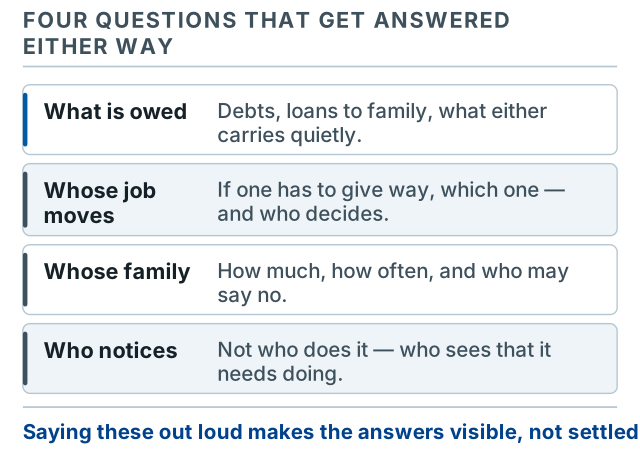
Ask about the things that will run on autopilot the moment you live a shared life: money, work and time, family, and how the household is actually kept. Each of those four areas fills in a default answer whether or not the two of you ever discussed it, and a default nobody chose is the material a first-year argument is made of.
A useful question before the wedding has three properties. It is answerable — you can respond tonight without research. It is specific — it asks what you would do, not what you believe in. And it costs something to answer honestly, which is why the polished version of an answer arrives first and the real one a moment later.
Two habits make this deck work. Both of you answer every question, so it stays a conversation rather than an interview. And either of you can say “I want to think about that one” without it counting as an answer, because a question that needs a night of thought is the kind worth asking.
- For example, “how do you feel about money?” gets you a philosophy. “What was the last thing you bought that you would rather I had not seen on the statement?” gets you an actual habit, an actual sum, and a laugh that makes the next question easier.
- For example, “do you want children?” gets a yes or a no. “If we had a baby next year, whose work would change first, and by how much?” gets the assumption underneath it — which is where two yeses can turn out to mean different things.
- Money
What is the size of purchase you would mention before making it?
One card from each area of the before-the-wedding deck: the question, not the topic.
There is a fifth area with no natural home, and it produces the strangest arguments of a first year: the assumptions neither of you thinks of as assumptions. What a marriage is supposed to change. Whether birthdays are a big event or a quiet one. How much of an argument is allowed to happen in front of other people. Whether an evening apart needs explaining. None of these feel worth a conversation until the day two versions collide, and then they feel like a betrayal of something that was never agreed. Asking now costs an evening; discovering it later costs considerably more.
A last practical note on setting. This works better on an ordinary evening than on a special one — a table at home, a walk, a long drive — because a night that has been designated as Important makes both of you answer as the person you would like to be. Spread the areas over several sittings rather than doing all of them at once, and stop while both of you still want another question.
Which money questions belong on the list?
The money questions worth asking are the concrete ones: what each of you owes today, what each of you earns, whether income becomes shared or stays separate, what counts as a purchase you would mention first, and who is expected to help which relatives. Attitudes about money are easy to agree on in the abstract and impossible to guess in practice.
Ask, and answer, in this order — from the facts to the habits to the futures:
- What do you owe right now, to whom, and on what schedule? Debt disclosed before a wedding is a fact; debt discovered afterwards is a story about concealment, and the story does more damage than the balance.
- Does income go into one pot, two pots, or a pot and two accounts? There is no correct answer, but there is a wrong process: finding out which model you are living in by accident.
- What is the size of purchase you would mention before making it? Say a figure out loud. The gap between two people’s figures is the argument you would otherwise have next spring.
- Who handles the bills, and does that person also get to decide? Administration quietly turns into authority unless someone says otherwise.
- What is saving for? A home, a buffer, a sabbatical, nothing in particular — the answers can differ more than either partner expects, and they set the tone of every small decision in between.
- Which relatives would you help financially, and would you tell me before you did?
- If one of us lost work for a long stretch, what would we cut first, and what would we protect?
The one to ask last, when the facts are on the table, is the uncomfortable one: what did money look like in the house you grew up in? People inherit a temperature about money — scarcity, secrecy, ease, impatience with anyone who worries about it — long before they inherit any of the money itself, and that temperature explains far more of a future argument than either salary does.
If any of these open something larger, the longer version lives on our page about budgeting for couples, including how to hold the conversation when money has already become a subject you both approach carefully.
The before-the-wedding deck, printable
That did not go through. Nothing was saved and nothing was sent. Try the address again, or write to us directly and we will add you by hand.
- What arrives
- One question worth asking your spouse this week, and the shortest honest account of when it works.
- What does not
- No rules with numbers in them, no promises about outcomes, and no third party ever gets the address.
Which questions are about family, work and time?
These questions ask who gets your hours: employers, parents, friends, and each other. They are less charged than money in the abstract and more charged in practice, because time is the resource neither of you can quietly top up, and because the answers involve people you did not marry.
Work and time
- What does a normal working week look like for you in a good year — and in a bad one?
- Is there a job or a city that would move us? Whose career gives way if two offers arrive at once?
- How much time alone do you need to feel like yourself? Say it as evenings, not as a feeling.
- What does a weekend look like when nothing is planned? One of you may be describing rest and the other may be describing waste.
Family
- Where do we spend the significant holidays, and who tells your mother?
- How much do our families get to know about our money, our plans, and our arguments?
- If a parent needed daily care, what would we do, and who would do it?
- What did your parents’ marriage do that you want to keep, and what do you want to leave behind? This one is worth asking slowly, because it is a question two people can live beside for years without ever putting into words.
The household
- Who cleans what, and how often does it have to happen before it counts as clean?
- Who notices when things run out? The person who notices is doing work the other person cannot see, and this is an unglamorous and durable source of resentment in a first year.
- Do we host? How often, and who does the cooking and the recovery?
Agreements about family time and household work hold better when they are stated as agreements between equals rather than rules issued by whoever cares more — which is the whole subject of our page on boundaries in marriage.
What do you do with an answer you did not want to hear?
Ask a second question before you react. An unwelcome answer before a wedding is unfinished more than it is final: it is the first sentence of a position the other person has not had to explain to anyone, including themselves. The follow-up — “since when?”, “what would that look like on a Tuesday?” — is where the real answer lives.
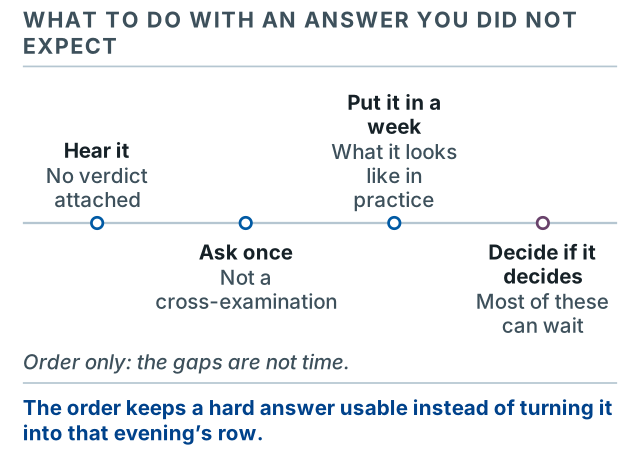
Three things help here. Keep the subject to the specific case rather than the whole character of the person in front of you. Say what you heard back before disagreeing with it, so you are arguing with a position and not with your version of it. And separate the disagreements that need a decision from the ones that only need a shared plan for revisiting them.
- For example, one partner says they expect to keep working the same hours after a child arrives. The reflex is to hear indifference. The follow-up — “what would the mornings look like, then?” — can produce something quite different: a person who has never been asked to picture a specific Tuesday and is doing it for the first time in the kitchen.
Some of what you turn up will not be solvable, and it is cheaper to learn that before the wedding than to discover it afterwards. The Seven Principles for Making Marriage Work — written by the researcher John Gottman with Nan Silver — treats part of what a couple argues about as perennial: temperament, tidiness, how much company either of you wants. The question that belongs to this stage is therefore not “can we settle this before the wedding?” but “which of these am I willing to carry unsettled, for a long time, without keeping a tally?” An honest answer to that is worth more than an agreement reached to get the evening over with. We set out the framework in our own words on the seven principles, and how the same sources are checked is on our sources page.
If a subject cannot be discussed at all without the evening ending badly, that is worth taking seriously as information about the conversation, not as a verdict on either of you — and if it has been that way for a long time, a page of questions is not where that belongs. A qualified professional is.
Which of these are worth asking again after the wedding?
All of the money and household questions, and the time questions along with them. Newlywed questions are largely the same questions with evidence attached: you now know what the household actually costs, whose weeks run over, and which holiday arrangement produced a silent drive home. The answers given before the wedding were predictions; the answers given after are reports.
A workable rhythm is one short sitting when something changes — a new job, a move, a shift in what money is doing — plus a standing conversation about the household that does not wait for a grievance to schedule it. What that looks like in a first year is the subject of our advice for newlyweds, and lighter prompts for ordinary evenings live in questions to ask your spouse.
One thing does change after the wedding. Before it, an unwelcome answer can feel like evidence about whether to go ahead; after it, the same answer is simply information about the life you are already building, which makes it easier to hear and easier to say. The questions that felt frightening to ask are not always the expensive ones: the household questions dismissed as too small to raise can turn out to be the ones that cost the most to leave alone.
Two questions in particular repay repeating in the first year: “what do you do more of now than you expected?” and “what have you stopped asking me about?” Both are quiet, and both surface the adjustments people make silently while trying to be easy to live with.
What this page does not do
A question list is a way to find out where you stand, not a verdict on whether to marry.
- We do not tell you whether to get married
- No answer on this page is a green light or a warning. The list surfaces where you differ; what you do with that is yours, and anyone claiming otherwise from a distance is guessing.
- We do not score the answers
- There is no threshold, no pass mark and no tally of matching answers. Couples who agree on everything before a wedding may simply not have asked specifically enough yet.
- We do not run pre-marriage programmes
- This is an editorial guide: no faith-based curriculum, no course to sell, no counselling standing behind it. When a question opens something the two of you cannot get through, the useful next step is a qualified professional, not a better-worded question.
- We do not print folk statistics
- The hardest year of marriage, the arguments a healthy couple is supposed to have, the familiar figures about money ending marriages — none of it appears here, because none of it survives checking.
Checked: 2026-09.