People read about marriage counseling questions for married couples long before they ever book anything — sometimes instead of booking anything. The curiosity is reasonable: it is hard to agree to a room you cannot picture. This page describes the kinds of questions couples counselors open with, what each question is doing, and which of them survive being asked at a kitchen table by the people they are about. Checked: 2026-09.
Marriage counseling questions are prompts a counselor uses to get a couple describing their relationship rather than re-arguing it. Nothing in them is clinical equipment. They are plain questions, put in a particular order, by somebody whose job is to notice what the two people answering cannot notice while they are answering. The order is what does the work, and it is the part a numbered list of the questions leaves out. Borrowing the questions is fair game. Pretending the borrowing makes you a counselor is not, and this page does not.
What are marriage counseling questions?
They are open questions about the relationship as a whole, asked in an order that starts far from the current conflict and moves toward it. A counselor is not gathering evidence about who is right. The questions are built to produce description — what happens, when, in what order, and what each partner makes of it — because when both partners describe the same week out loud, the two accounts turn out not to match.
These questions are not a quiz, and the difference matters. A quiz has right answers and a score; an opening question has neither. Counselors ask things they already expect each partner to answer differently — such as when the drift started, or what a normal week is supposed to look like — precisely because the gap between the answers is the material. A couple who answer identically have not passed anything; they have simply arrived at a session with less to work on that evening.
That is also why so many of the opening questions sound almost sentimental. Asking how a couple met is not small talk. It asks both partners to talk about each other in a register they may not have used for a while, and it establishes that the relationship has a history longer than its current problem.
The other thing these questions do is slow the pace. A couple mid-argument talks in summaries: he never, she always, we’ve been through this. A question about a specific Tuesday cannot be answered in summaries. This is the mechanism worth stealing, and it is the same mechanism behind every set on our question decks for married couples page.
What do counselors ask first?
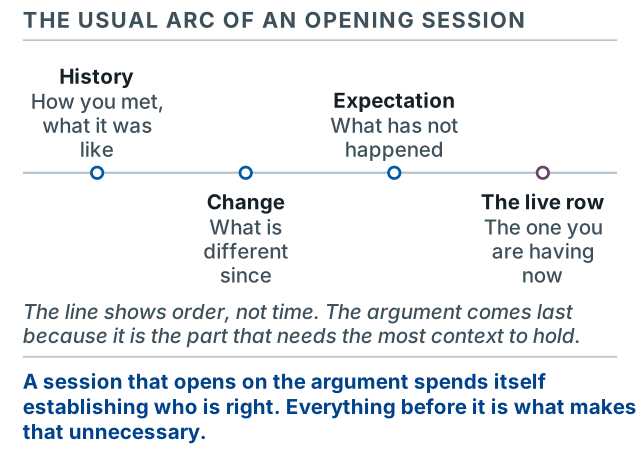
History and orientation come first: how you met, what the early years were like, when things shifted, what each of you expected marriage to be, and what a good outcome would look like. The presenting argument gets its turn, but not at the start — it is the loudest material in the room, and starting there reproduces the fight instead of describing it.
The categories below cover the ground an opening session moves through. The wording changes from practitioner to practitioner; what each question is for does not.
- History. How you met, what the early years together looked like, what you liked about each other before you had a shared calendar.
- Change. When did it start feeling different, and what else was happening at that time — a move, a baby, a job, an illness, a bereavement.
- Expectation. What each of you assumed married life would be, and where that assumption came from. This is the question that turns up inherited scripts nobody ever agreed to.
- Current pattern. Not the content of the argument but its shape: who raises things, who withdraws, how it ends, how long it takes before either of you speaks normally again.
- Direction. What each of you would want more of, and what would have to be true for this to feel better later in the year.
The direction question deserves its own note, because it is the one that gets skipped at home. Asking what better would look like sounds soft, and it does more work than any of the others: it converts a complaint that has been circling for a long time into something specific enough to agree or disagree with. A partner who says I want us to eat dinner together on weeknights has made a proposal. A partner who says you are never here has made a summary, and summaries cannot be accepted or declined.
Counselors also put the same question to each partner separately rather than letting the couple answer as a unit. The habit is worth copying. When one person answers for both — we have always been fine with that — the session loses the only thing it came for, which is both accounts of the same marriage instead of a single agreed version of it.
| Question | What it is doing | At home? |
|---|---|---|
| How did you meet? | Restores a longer history than the current problem | Yes — works well over dinner |
| What changed, and when? | Locates the shift in time and context, not in a person | Yes — best at a calm hour |
| What did you expect marriage to be? | Surfaces unspoken assumptions about money, time, family | Yes — expect a long answer |
| What happens when you argue? | Describes the pattern instead of re-running it | Carefully — easy to tip into blame |
| What would better look like? | Turns complaint into a request | Yes — the most useful one to borrow |
| What are you each bringing from your own family? | Traces where the defaults came from | Only if both of you want to |
Counselors also pay close attention to how a couple argues, not only to what the argument is about. That emphasis has a long research history behind it — including Gottman and Levenson’s research on conflict and marital breakup, which studied how couples behave and what their bodies do during conflict rather than which partner had the better case. We describe that work qualitatively and keep the figures off this site on purpose; the reasoning is on our editorial policy page.
Which of these questions can you use at home?
The wide ones travel; the sharp ones do not. History, change, expectation and direction are safe to ask across a table; they invite stories, and stories are hard to weaponize. The questions that need a third person present are the ones that ask each partner to account for their part in a pattern while the other listens.
A few that work at home, with the shape of a real evening around them:
- For example, “What did you think our week would look like when we got married?” asked on a Sunday evening, with the answer allowed to be unflattering. One partner says they pictured cooking together; the other says they pictured being left alone after work. Nobody is wrong, and now it is out loud.
- For instance, “When did it start feeling like this?” — followed by nothing. No correction, no counter-date. The value is in the answer being allowed to stand, even if you would date the change differently.
- Consider ending with “What would you want more of before the year is out?” Requests are workable in a way that complaints are not, and a request small enough to fit into an ordinary week is a request that might actually happen.
Rules that keep the borrowing honest: ask a single question an evening rather than a set; ask at an hour when neither of you is running on empty; and agree in advance that either of you can say not tonight without it counting as a refusal. If the answer to a wide question turns into a specific grievance, that is fine — it means you found the live material — but do not chase it into an argument late at night.
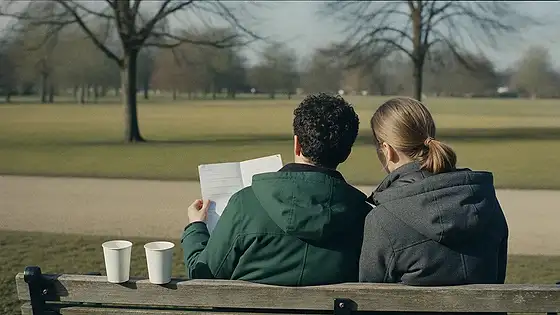
Setting matters more than it seems it should. The same question that opens something useful on a walk can land as an interrogation across a kitchen table with a phone lighting up between you. Side-by-side beats face-to-face for anything heavier than light conversation, partly because neither of you has to hold eye contact while working out what you actually think. A drive, a dog, a sink full of dishes: all of them give the answer somewhere to go while it is being assembled.
The thing you cannot recreate is the third person. A counselor interrupts, slows things down, and notices what neither partner can notice while talking. At home, you are both participants, which is why the borrowed questions work best on ordinary evenings and badly in the middle of a bad week.
The question sets we actually use, as a printable deck
That did not go through. Nothing was saved and nothing was sent. Try the address again, or write to us directly and we will add you by hand.
- What arrives
- One question worth asking your spouse this week, and the shortest honest account of when it works.
- What does not
- No rules with numbers in them, no promises about outcomes, and no third party ever gets the address.
What do you do with an answer that lands badly?
You let it be information rather than a verdict, and you postpone the response. An honest answer to a wide question will sometimes contain something you did not want to know — that your partner has felt alone since the baby, that they dread Sunday evenings at your mother’s, that they stopped expecting you to ask.
The instinct is to correct the record immediately. Resist it for the rest of the evening. A first response made inside the sting is a defense of yourself more than a reply to what was actually said, and it teaches the other person that honest answers are expensive.
What helps is a plain acknowledgment and a return time: I did not know that, and I want to talk about it properly — can we come back to it tomorrow? Then come back, because the whole value of the practice rests on that. The mechanics of having the harder version of the conversation are covered in our guide to communicating better with your spouse, and lighter prompts for evenings that do not need heavy lifting live in questions to ask your spouse.
When is a question a matter for a professional, not a page?
When the conversation cannot get started, cannot get finished, or cannot happen safely. Those are distinct situations, and an article is a poor substitute for a professional in all of them.
Cannot get started: one of you will not sit down at all, or every attempt turns into the same argument within minutes. Cannot get finished: the subject comes up again and again over a long stretch and lands in the same place every time, which is a sign that something underneath it has never been named. If either describes your marriage, the useful next step is a qualified professional, not a better question — not because the marriage is broken, but because a trained third person is the specific thing a page cannot be.
Cannot happen safely: if either of you feels unsafe, this is not a conversation to arrange at your kitchen table, and this site is not the right resource. That belongs with qualified professionals and appropriate services, and we say so plainly rather than writing around it. Where our material comes from and where our limits are is set out on our sources page.
There is also a plainer version of the answer. Some couples read a page like this, ask a few of the questions, and find the conversation opens on its own. Others find that every route in is blocked. The second group is not a worse marriage; it is a marriage where the useful next step costs money and a calendar entry instead of an evening.
What this page does not do
This is an editorial description of questions that circulate in couples work, written for people who want to know what they would be walking into. Its limits are worth stating.
- Replace counseling
- Borrowing the questions is not attending a session. There is no third person here, nobody trained is watching the conversation, and nothing on this page is designed to substitute for that.
- Assess your marriage
- We do not interpret answers, score them, or tell you what a particular reply means about your relationship. A page cannot see your marriage and should not pretend otherwise.
- Rank methods or practitioners
- We do not compare approaches, recommend clinics or services, and carry no affiliate arrangements with anyone offering them. Choosing a professional is outside what an editorial page can honestly help with.
- Promise an outcome
- No question, asked well or badly, settles anything by itself. The questions make description easier; what the description leads to belongs to the people having the conversation.
- Print a transcript
- There is no single script that every counselor uses. What is above is a working summary of common opening categories, not a reproduction of anyone's session.
If you want somewhere gentler to start, the question decks collect sets sorted by the evening you are actually in rather than by the problem you are worried about. The questions counselors open with are wider than they sound, and that width is the useful part: they ask a couple to describe a marriage, not to prosecute one.