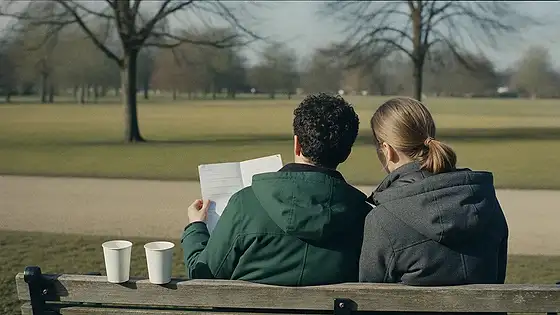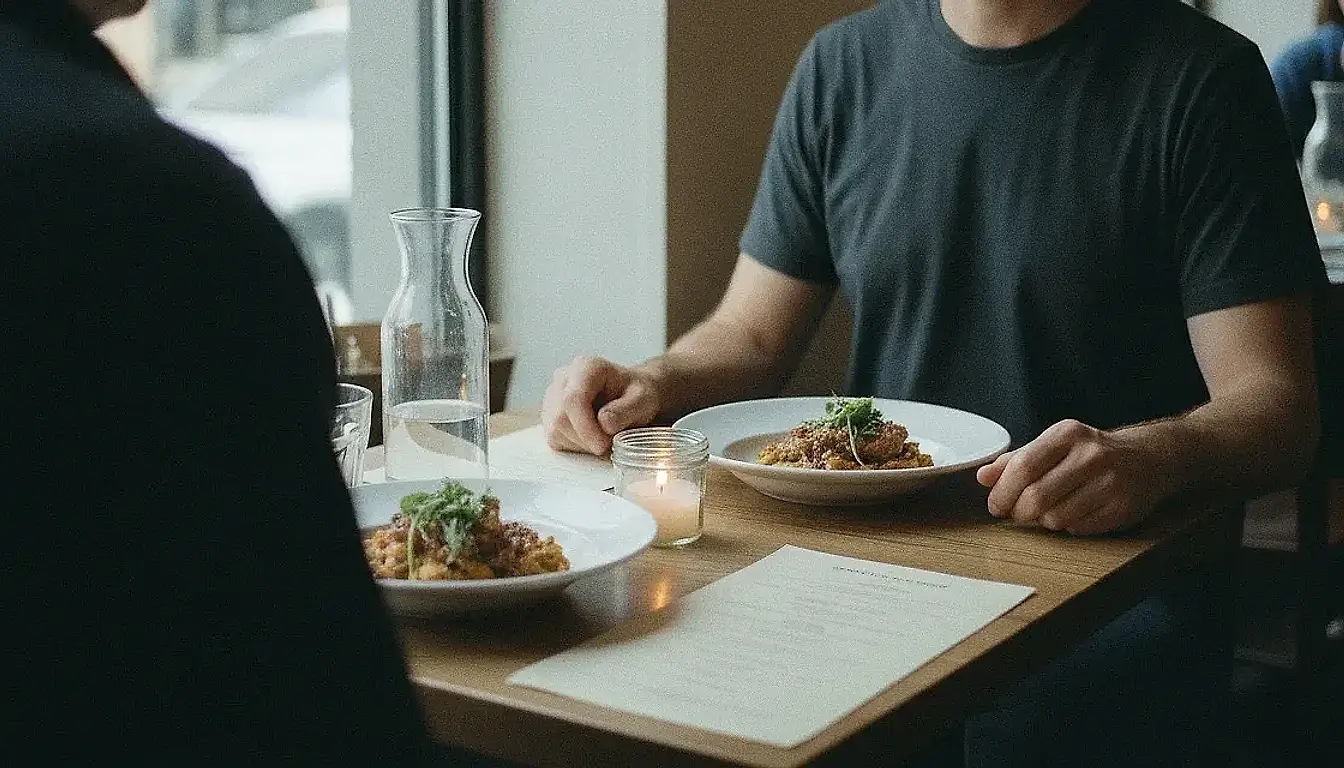
A date night question is a prompt built for one specific evening out, which is a harder brief than it sounds. The test is not whether the question reads well on a list. It is whether it holds up at a table with the food arriving, a waiter appearing mid-sentence, and two people who have already spent the day’s supply of attention elsewhere. Small talk clears that bar and then dies on its own answer; the relationship review clears it and turns an evening off into an evening of assessment. Good date night questions for married couples sit in the gap between those two ways of failing.
The decks below are grouped by where you will be rather than by what the question is about, because the room does much of the work. A loud table, a dark car and a walk through a familiar neighbourhood each support a different weight of question. If the evening itself is still unplanned, the ideas belong on date night ideas for married couples; this page assumes the night exists and you want something to say once you are sitting down. The other decks live on the questions for married couples hub.
What makes a date night question different from any other question?
A date night question has to survive conditions that other good questions never face: background noise, a waiter arriving mid-sentence, and people who have already used up a day’s worth of attention. So it is judged on a few practical things — whether it can be answered in a sentence, whether that sentence is interesting enough to ask about again, and whether it can be skipped without anything being read into the skip.
That last condition is the one that gets dropped first. A question that carries a penalty for not answering it is not a date night question, whatever it is about. If “what do you want the next year to look like” arrives at the wrong moment, the honest answer may be “I have not thought about it”, and that answer has to be allowed to stand without becoming evidence of something.
Married couples also start from a different place than people on early dates. You already know the biography. What is missing is anything current: what the other person has been thinking about lately, what they changed their mind about, what they noticed this week and did not bother mentioning. Good questions here go after the recent and the specific, not the foundational.
- For example, “what is the best thing you ate this month” works at a noisy table because it needs no context, has a real answer, and opens straight onto a second question about where and who with. Nothing about it requires either of you to be at your sharpest.
- For instance, “what have you changed your mind about this year” is a heavier version of the same shape: still answerable in a sentence, still about the person rather than about the marriage, but it rewards a slower setting than a restaurant on a Friday.
- Opener · at the table
What was the best thing you ate this month, and where were you?
Cards from the date night deck, sorted by setting rather than by theme.
Which questions open a night well?
Openers should be light, specific and pointed at the last few weeks rather than the last few years. The job of the first question is not to produce a meaningful conversation; it is to get both of you talking in full sentences before the food arrives, so that a better question later has somewhere to land.
Openers that behave well at a table:
- What was the best thing you ate this month, and where were you?
- What is the last thing that made you laugh out loud when no one was around?
- If tomorrow were a free Saturday with no obligations, what would actually happen?
- What have you been reading, watching or listening to that you have not mentioned yet?
- Which small thing went right this week that nobody noticed?
- What is a place in this city you keep meaning to go back to?
There is also a difference between a question and an opening gambit. A married couple arrives at a table carrying the day, and the first exchange goes on unloading it: the traffic, the last email, whether the babysitter texted. That is not a failure of the deck. Let the unloading happen, order, and then ask the first real question once the noise of the day has been said out loud and put down.
Openers that behave badly, and why: anything that starts with “why do you always”, anything asking for a rating of the relationship, and anything that requires an inventory of the year. The blaming openers invite defence, and the inventory invites a sigh. Save the weight for later, and for a different setting.
Consider the difference between “how are we doing” and “what has been the best part of the last few weeks for you”. The first is a question about the marriage and it produces either reassurance or an argument. The second is a question about a person and it produces a story, which is what the evening was for.
The printable date night deck
That did not go through. Nothing was saved and nothing was sent. Try the address again, or write to us directly and we will add you by hand.
- What arrives
- One question worth asking your spouse this week, and the shortest honest account of when it works.
- What does not
- No rules with numbers in them, no promises about outcomes, and no third party ever gets the address.
Which follow-up takes a good answer one step deeper?
The follow-up matters more than the question, and the useful move is small: ask what made that the answer. Not why they think that, which sounds like cross-examination, but what the specific thing was — the moment, the detail, the reason it came to mind first. One step down, then let the subject go where it wants.
These follow-ups cover the answers a deck tends to produce:
- What made that the one? Turns a preference into a scene. “The best thing I ate this month” becomes a Tuesday, a bad day, and a place with terrible chairs.
- When did that change? Useful whenever an answer surprises you. People revise what they like and what they want quietly, without announcing the revision.
- What would that actually look like? For anything hypothetical. Free Saturdays and someday-plans get interesting the moment they acquire a time of day and a first step.
The reason to stop at one step is that further steps stop being curiosity and start being interrogation. A question that keeps drilling reads as suspicion even when none is meant, and it teaches the other person to give shorter answers next time. The aim of a follow-up is to make the answer specific, not to make it complete.
It also helps to notice which answers were rehearsed. An obvious question has a stock reply waiting for it, delivered smoothly and containing nothing. A rehearsed answer is not evasion; it is just the version that comes out without thinking. The follow-up is what gets past it, which is why a well-worn opener plus genuine curiosity beats a long list worked through in order.
There is a companion move that is not a question at all: say your own answer first sometimes. A prompt offered as a trade — here is mine, what is yours — lands differently from a prompt issued across a table. It signals that you are both playing rather than one of you assessing.
Which questions work in a car, on a walk, or at home?
Side-by-side settings carry heavier questions than a table does, because neither of you has to hold eye contact while thinking. A car at night, a walk on a familiar route and a kitchen with something on the stove all give the eyes somewhere else to go, and that turns out to be what makes a slower answer possible.
| Setting | What it gives you | Question weight that fits |
|---|---|---|
| Restaurant or bar | Noise, interruptions, a shared focus on the food | Light and specific: recent, answerable in a sentence, easy to skip |
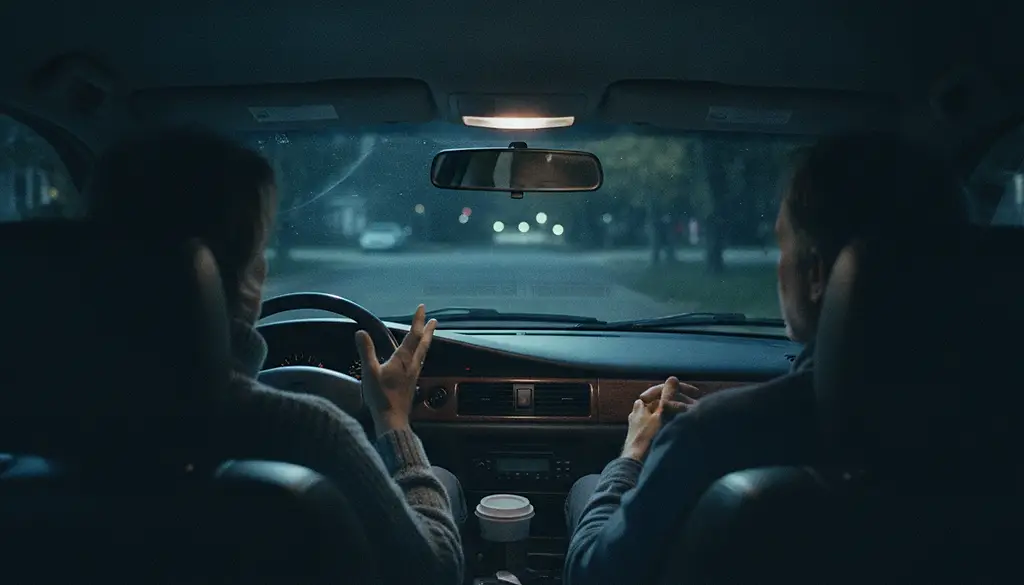
| Car, at night | No eye contact, a known end time, nothing to look at | Medium: what changed this year, what you would do differently, plans not yet said out loud |
| Walk in a familiar place | Movement, side by side, no waiter and no bill | Medium to heavy: what you want the next year to hold, what you have been putting off |
| Kitchen, cooking together | Hands busy, natural pauses, home ground | Light to medium: memories, small preferences, the ordinary texture of the week |
| Sofa, screens off | Comfort, privacy, no time limit | Heavier if both of you are willing — and easy to end early if not |
Questions for the car, where the road does the work of a neutral thing to look at: what have you changed your mind about this year, what would you do differently about the last big decision we made, what is something you want to try that you have not said out loud yet, and what part of this year would you keep exactly as it was.
Questions for a walk, where the pace makes long answers comfortable: what do you want the next year to hold that this one did not, what have you been putting off, what is something you used to do that you miss, and what would a good ordinary week look like for you now.
The other thing a setting decides is how a conversation ends. A restaurant has a bill, a walk has a front door, and a car has an arrival — each of them a natural stop that lets a bigger question be left unfinished without anyone feeling cut off. That is a feature worth using deliberately. Ask the heavier question with enough of the drive left to hear the answer, and accept that the rest of it can wait for another night rather than being finished in a car park.
Questions for the kitchen or the sofa, where home ground makes small questions safe: which of our habits would you quietly retire, what is the meal you would want on a hard day, which trip would you take again, and what is the nicest thing anyone has said to you recently.
Heavier questions have a practical limit worth respecting. In the physiology-of-conflict research, Levenson and Gottman looked at what happens in the body while a couple talks through a disagreement — an interest in the state the two people are in, not only in the words they choose. On a date night the useful reading of that is a scheduling one rather than a diagnosis: a question that raises the temperature belongs somewhere with an exit, not at a table with a bill still coming. If a subject clearly wants a proper conversation, park it and give it its own evening. How to reopen a subject that has been parked for a while is covered on how to reconnect with your spouse, and the gentler end of the same territory sits on how to romance your spouse.
For the shape of a whole evening built around questions rather than a single prompt, the game-style set is on how well do you know your spouse. The sources behind the qualitative claims on this page — including Gottman and Silver’s The Seven Principles for Making Marriage Work, a couples’ guide that argues ordinary knowledge of each other’s lives carries as much weight as argument technique — are listed on our sources page. Checked: 2026-09.
What this page does not do
A question list is a small object and it is easy to oversell. These are the limits we hold to.
- It does not promise a good evening
- Questions remove the work of thinking of something to say. They cannot supply the appetite for the conversation, and an evening where one of you would rather be asleep is not a question-list problem.
- It does not run a relationship assessment
- Nothing here asks either of you to grade the marriage, rank the other person, or produce a verdict over dinner. Questions about us are a different genre and they belong to a different evening.
- It does not do the suggestive deck
- Plenty of lists chase attention with questions written to be read rather than asked. This one is written to be used at a table where a waiter is about to arrive.
- It does not carry a religious frame
- Much of what ranks for this search comes with one. This page is secular by choice: no scripture, no vows-as-sermon, nothing addressed to the reader as a congregation.
What it does stand behind
- Sorting by setting
- The strongest practical claim here: a car and a restaurant table support different weights of question, and matching them is much of the difference between a good prompt and an awkward one.
- The one-step-deeper follow-up
- Asking what made that the answer converts a preference into a scene. One step, then let it go — that is where the specifics that make an evening memorable actually come from.
- The right to skip
- Every question here can be passed on without explanation. A deck that penalises a skip stops being a game and starts being an examination.